
Tirzepatide: a second receptor, a head-to-head trial, and the copies its maker tested
In SURMOUNT-5, published in 2025, 751 adults with obesity but without type 2 diabetes were randomly assigned to tirzepatide or to semaglutide for 72 weeks. Weight fell by a model-estimated average of 20.2% on tirzepatide and 13.7% on semaglutide. Before the trial, its authors wrote, how the two compared in this population was unknown. Eli Lilly, which makes tirzepatide, paid for it, and participants knew which drug they were taking.
Two questions sit behind that result for someone who trains. What a second hormone receptor adds, and what happens to muscle. The first has a partial answer. The second has barely been asked.
Why a second receptor
Semaglutide acts on the receptor for GLP-1, a gut hormone. Tirzepatide acts on two: GLP-1 and GIP, glucose-dependent insulinotropic polypeptide. It is a peptide modified with a fatty acid, designed for long action.
The 2018 paper introducing it, under the code LY3298176, states the question it was built to answer: "whether the metabolic action of GIP adds to the established clinical benefits of selective GLP-1 receptor agonists in type 2 diabetes mellitus." In mice, it reduced body weight and food intake more than a GLP-1 agonist alone. The first human study gave it, a comparison drug or placebo to 142 people.
Whether the extra weight loss in people comes from GIP itself, from how tirzepatide acts on the GLP-1 receptor, or from both is something the trials below were not designed to separate.
What the trials measured
In SURMOUNT-1, a double-blind trial published in 2022, 2,539 adults with obesity, or overweight with a weight-related condition, and without diabetes received tirzepatide or placebo for 72 weeks. Mean weight fell by 15.0% to 20.9% across the tirzepatide groups and by 3.1% on placebo. Gastrointestinal side effects were the most common, mostly mild to moderate. Adverse events led 4.3% to 7.1% of participants in the tirzepatide groups to stop treatment, against 2.6% on placebo. Lilly supported the trial.
SURMOUNT-5 then set the two drugs against each other in people without diabetes. An earlier comparison, SURPASS-2, had done so in people with type 2 diabetes, with blood sugar control as its main outcome.
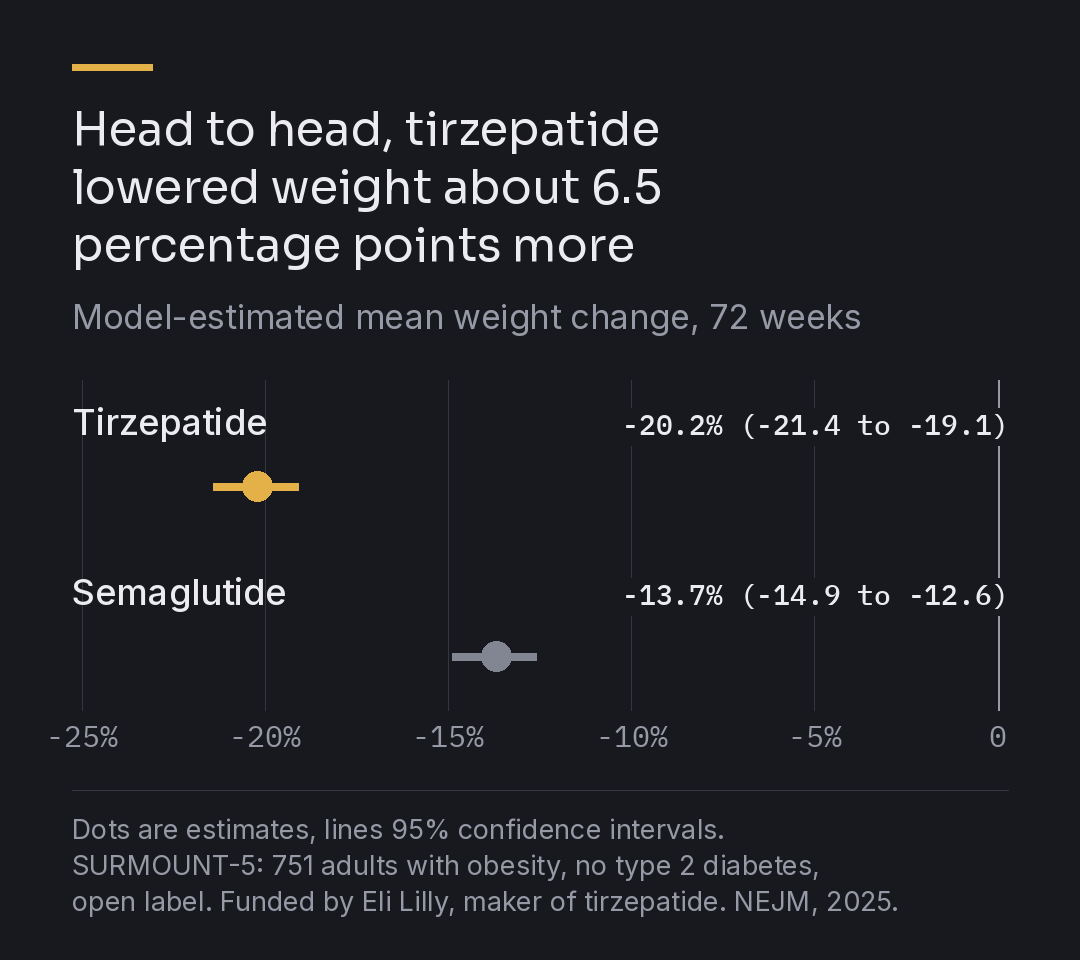
Waist circumference fell by 18.4 cm on tirzepatide and 13.0 cm on semaglutide. In both groups the most common side effects were gastrointestinal. Randomisation makes the groups comparable, but in an open-label trial participants and clinicians know the treatment.
What happened to muscle
Most of what is known about body composition on tirzepatide comes from scans of lean mass, which includes organs and water as well as muscle. A DXA substudy of SURMOUNT-1, which Vayl covered in an earlier article, found that about 75% of the weight lost was fat mass and 25% lean mass, in both the tirzepatide and placebo groups. Lean mass is not the same as skeletal muscle, and a share of weight lost says nothing about strength.
Neither the SURMOUNT-1 nor the SURMOUNT-5 abstract reports muscle or strength outcomes in people who lift. A trial protocol published in 2026 describes a study in Kuwait that will test resistance exercise and extra protein in people taking semaglutide or tirzepatide. It is a plan, not a result. Vayl looked at the MRI evidence for semaglutide here.
The copies
From December 2022, tirzepatide injection was on the FDA's shortage list, which allowed US pharmacies to compound copies. On 19 December 2024, after reevaluating an earlier decision, the agency reaffirmed that the shortage was resolved. Under its stated timeline, the shortage-related grace period for state-licensed pharmacies ended after a federal court ruling on 5 March 2025, and for larger outsourcing facilities on 19 March 2025.
The end of the shortage restored the limits on routinely compounding products that are essentially copies of an approved drug. The FDA says an added ingredient does not automatically take a product outside its copy restrictions. Under section 503A, one exception requires a prescriber to determine and document that a change produces a significant difference for an identified individual patient. Between February and March 2025, pharmacy researchers in Storrs, Connecticut, searched compounding websites and found 33 semaglutide or tirzepatide products that differed from the approved ones, about a third of them with tirzepatide. Nearly half combined the drug with other ingredients, including vitamin B12, glycine, niacinamide, docusate or the anti-nausea drug ondansetron. The authors found "little justification" for adding nutrients or docusate and called the efficacy and safety of these products largely unknown.
One of those combinations has now been tested in a laboratory. In a 2026 study, Lilly researchers tested samples of compounded tirzepatide with vitamin B12 obtained from various US sources and reported a previously unidentified impurity, formed by a reaction between tirzepatide and certain forms of B12, at substantial levels. They write that its clinical effects are unknown. All of the authors work for Eli Lilly, whose approved drug competes with these products. It is a chemical finding that independent laboratories could confirm or contradict, not a measure of harm in patients.
Separately, the FDA says it had received more than 730 reports of adverse events associated with compounded tirzepatide as of 31 May 2026. Those reports show neither that the products caused the events nor how often events occur, and these aggregate figures cannot establish whether the impurity contributed.
The FDA's April proposal and WADA
On 30 April 2026, the FDA proposed excluding tirzepatide, semaglutide and liraglutide from the 503B bulks list, saying it had not identified a clinical need for outsourcing facilities to compound them from bulk substances. The agency said it would consider comments before a final determination.
In sport, tirzepatide is not on the World Anti-Doping Agency's 2026 Prohibited List. The 2026 Monitoring Program includes markers of tirzepatide and semaglutide, in and out of competition, to detect possible patterns of misuse.
What is still missing
The trials showed how much weight tirzepatide removes compared with placebo and with semaglutide. Their abstracts do not report what it does to the muscle and strength of people who lift, and the head-to-head trial in people without diabetes was open label and funded by the maker of one drug. On the compounded products, the only chemical analysis described here came from the same company, and the FDA's adverse event reports cannot establish cause. What would move the question is an independent analysis of what compounded products contain, and a trial that measures muscle and strength in people who train.
Sources
- Coskun and colleagues, Molecular Metabolism, 2018: LY3298176, a dual GIP and GLP-1 receptor agonist doi.org
- Jastreboff and colleagues, New England Journal of Medicine, 2022: SURMOUNT-1 doi.org
- Aronne and colleagues, New England Journal of Medicine, 2025: SURMOUNT-5, tirzepatide compared with semaglutide doi.org
- Frías and colleagues, New England Journal of Medicine, 2021: SURPASS-2, tirzepatide versus semaglutide in type 2 diabetes doi.org
- Look and colleagues, Diabetes, Obesity and Metabolism, 2025: DXA substudy of SURMOUNT-1 pubmed.ncbi.nlm.nih.gov
- FDA, 19 December 2024: declaratory order on the resolution of the tirzepatide injection shortage fda.gov
- FDA: policies for compounders as national GLP-1 supply stabilises fda.gov
- FDA, 30 April 2026: proposal to exclude semaglutide, tirzepatide and liraglutide from the 503B bulks list fda.gov
- Belcourt and colleagues, Annals of Pharmacotherapy, 2026: unique compounded semaglutide and tirzepatide products doi.org
- Expert Opinion on Drug Safety, 2026: an impurity in compounded tirzepatide with vitamin B12 (authors employed by Eli Lilly) doi.org
- LEAN trial protocol, 2026: resistance exercise and protein during semaglutide and tirzepatide therapy pubmed.ncbi.nlm.nih.gov
- FDA: concerns with unapproved GLP-1 drugs used for weight loss fda.gov
- World Anti-Doping Agency, 2026 Monitoring Program wada-ama.org
For educational purposes only. Not medical advice.
Skinfold, bioimpedance and DXA, each reading compared only with its own method.
First month free for new subscribers.