
Semaglutide and muscle: what 55 MRI scans can and cannot say
Of the 1,407 adults with obesity randomised in STEP UP, a 72-week trial of semaglutide, 55 had a usable MRI scan of their body at the start. Six of those 55 were on placebo. The analysis of those scans, published in September with Novo Nordisk employees among its authors, measured muscle volume inside a randomised trial, and its size is the reason to read it carefully.
What the scans found
The analysis was prespecified. It pooled the trial's two semaglutide arms, 49 people in all, and compared them with the six on placebo. MRI measures tissue volume from images rather than estimating it from electrical resistance, as bioimpedance devices do. A Vayl article on 4 November looked at the same question with bioimpedance estimates from routine care.
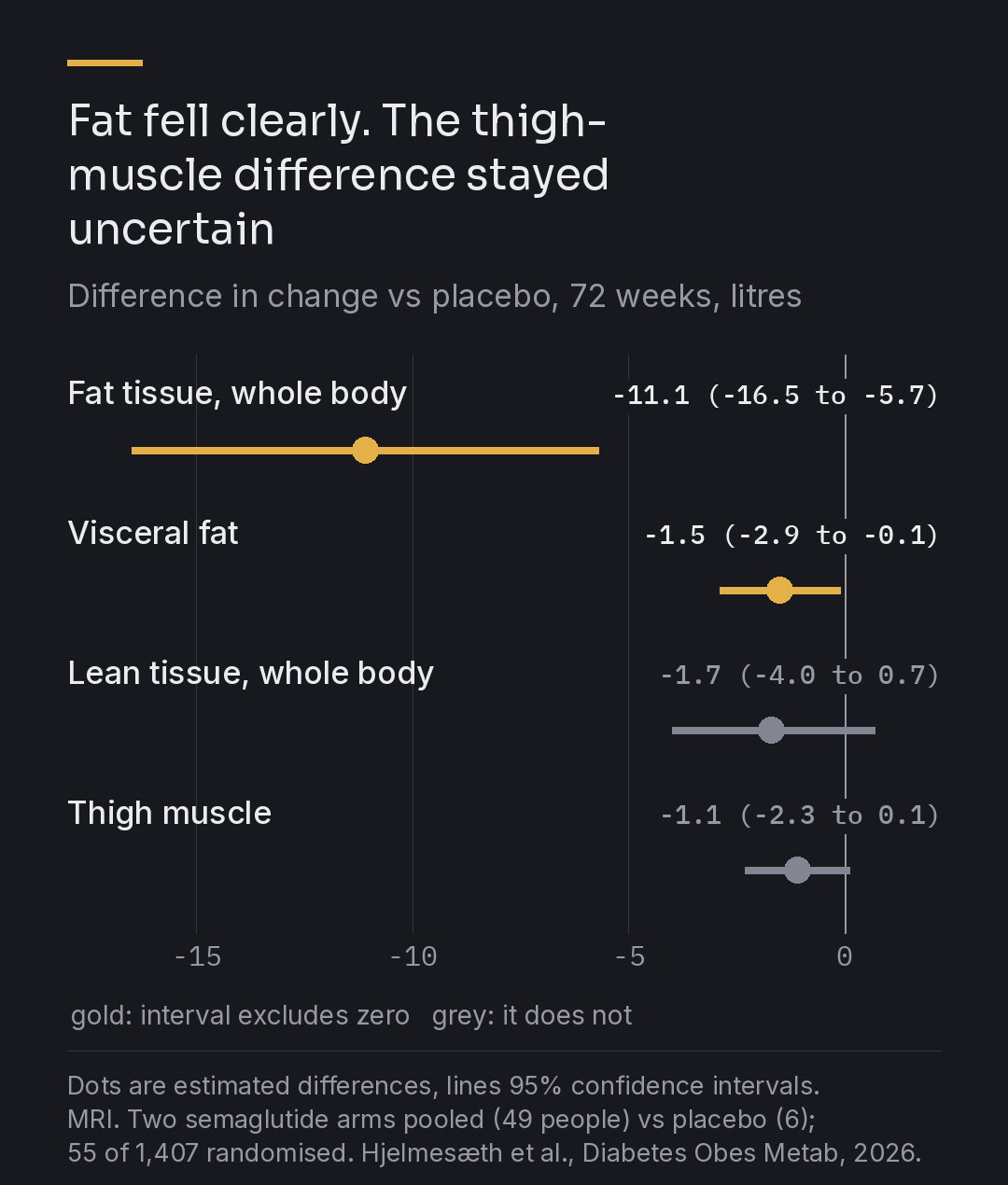
Compared with placebo, the semaglutide group lost an estimated 11.1 more litres of fat tissue, a difference the analysis could clearly detect. Thigh muscle volume fell by an estimated 1.1 litres more than on placebo, but the 95% confidence interval ran from 2.3 litres more lost than on placebo to 0.1 litres less, so the analysis could not rule out no difference. Whole-body lean tissue showed the same pattern. Fat inside the thigh muscle fell by 0.92 percentage points more on semaglutide, a difference the analysis did detect.
For function, the abstract reports a mean of 13 repetitions of a 30-second chair stand at the start and 15 at week 72 in the pooled semaglutide and placebo groups, with no estimate of the difference between them. The authors conclude that semaglutide plus lifestyle intervention was associated with less fat, less muscle volume and less fat within muscle, "with a preserved number of sit-to-stand repetitions."
The size of the placebo group is the limit on all of it. With six people for comparison, the intervals allow both a meaningful additional loss of muscle compared with placebo and no difference between the groups. Both groups could have lost some muscle either way, since the comparison is between their changes. The abstract reports no analysis in people who train with weights and no test of strength under load.
A hormone redesigned to stay
GLP-1 is a hormone the gut releases after eating. It prompts the pancreas to release insulin when blood sugar is high, slows the emptying of the stomach and reduces appetite. The natural hormone is broken down within minutes by an enzyme called DPP-4.
Semaglutide is a modified version built to last. In the 2015 paper describing its discovery, chemists at Novo Nordisk describe two amino acid substitutions compared with human GLP-1, at positions 8 and 34, and a fatty acid attached at lysine 26. They write that the fatty acid and the chemistry linking it to the peptide were "the key features" for strong binding to albumin, a blood protein, and for prolonged action. The trade was deliberate: semaglutide binds the GLP-1 receptor about three times less tightly than liraglutide, its predecessor, but binds albumin more strongly. In mini-pigs, its half-life after an intravenous injection was 46.1 hours.
What the large trials measured
Semaglutide has been studied in large randomised trials involving tens of thousands of participants, funded by Novo Nordisk.
In STEP 1, 1,961 adults with overweight or obesity and no diabetes received semaglutide or placebo alongside a lifestyle programme. Over 68 weeks, body weight fell by an average of 14.9% on semaglutide and 2.4% on placebo. Nausea and diarrhoea were the most common adverse events.
In SELECT, 17,604 people aged 45 or older with established cardiovascular disease, overweight or obesity and no diabetes were followed for a mean of 39.8 months. A heart attack, stroke or cardiovascular death occurred in 6.5% of the semaglutide group and 8.0% of the placebo group, a hazard ratio of 0.80. Adverse events led 16.6% of the semaglutide group to stop permanently, against 8.2% on placebo.
In FLOW, 3,533 people with type 2 diabetes and chronic kidney disease had a 24% lower risk of a composite of kidney failure, a substantial loss of kidney function, or death from kidney-related or cardiovascular causes. The trial was stopped early after an interim analysis.
ESSENCE was designed to follow people with steatohepatitis, liver inflammation from fatty liver disease, and moderate to advanced scarring for 240 weeks. Its published 2025 interim analysis of the first 800 participants, at week 72, reported resolution of steatohepatitis without worsening of scarring in 62.9% on semaglutide and 34.3% on placebo, and less scarring without worsening of steatohepatitis in 36.8% and 22.4%. Both are biopsy findings, not counts of liver failure or death.
The pens that were not semaglutide
One safety problem has nothing to do with the molecule. It is what gets sold under its name. Falsified products, which claim to be the branded medicine, are a different category from compounded versions made by pharmacies.
Researchers in Italy searched EudraVigilance, the European database of suspected side effects, from 2018 to 2025 and found 234 reports involving potentially counterfeit semaglutide. Of the suspected reactions, 89.3% were classed as serious. Compared with reports classified as involving non-counterfeit semaglutide, these reports mentioned hypoglycaemia, malaise and "drug ineffective" more often. They are suspected safety reports, not an estimate of risk among users and not chemical confirmation of what each product contained.
In some cases, the contents were confirmed. In Italy, a 31-year-old woman arrived at an emergency department in a hypoglycaemic coma after injecting what a website sold her as Ozempic; toxicology found insulin in the vial. Doctors in the Netherlands described two people with neither diabetes nor obesity who arrived in a coma from synthetic insulin after injecting semaglutide obtained without a prescription; they needed up to two days of continuous glucose infusion. The authors note that semaglutide on its own is not associated with significant hypoglycaemia in healthy individuals. The FDA's page on unapproved GLP-1 drugs says counterfeit Ozempic has been found in the United States and may contain the wrong ingredients, too little, too much or none of the active ingredient.
Where the rules stand
Semaglutide is an approved medicine, marketed by Novo Nordisk under brands including Ozempic, Rybelsus and Wegovy.
In the United States, pharmacies were able to compound copies while the drug was in shortage. The FDA declared the shortage of semaglutide injection resolved on 21 February 2025. The shortage-related enforcement discretion ended for state-licensed pharmacies after a federal court decision on 24 April 2025, and for outsourcing facilities on 22 May 2025. On 30 April 2026, the agency proposed excluding semaglutide, tirzepatide and liraglutide from the list of bulk substances outsourcing facilities may compound from, finding no clinical need.
In sport, semaglutide is not on the World Anti-Doping Agency's 2026 Prohibited List. The agency's 2026 Monitoring Program includes markers of semaglutide and tirzepatide, in and out of competition, to detect possible patterns of misuse.
What is still missing
The large trials answered the questions they were built for: weight, the heart, the kidney, the liver. Muscle composition was assessed in a prespecified secondary analysis that reached 55 of STEP UP's 1,407 participants. These sources cannot establish what semaglutide does to the muscle and strength of people who lift. That will take a trial that scans enough people on both sides of the comparison, and puts a load in their hands.
Sources
- Hjelmesæth and colleagues, Diabetes, Obesity and Metabolism, 2026: thigh muscle volume, fat infiltration and physical function in STEP UP doi.org
- Lau and colleagues, Journal of Medicinal Chemistry, 2015: discovery of semaglutide doi.org
- Wilding and colleagues, New England Journal of Medicine, 2021: STEP 1 doi.org
- Lincoff and colleagues, New England Journal of Medicine, 2023: SELECT cardiovascular outcomes trial doi.org
- Perkovic and colleagues, New England Journal of Medicine, 2024: FLOW kidney outcomes trial doi.org
- Sanyal and colleagues, New England Journal of Medicine, 2025: ESSENCE trial in steatohepatitis doi.org
- Zinzi and colleagues, Frontiers in Pharmacology, 2026: potential counterfeit semaglutide in EudraVigilance doi.org
- Case report, European Journal of Hospital Pharmacy, 2026: hypoglycaemic coma from a falsified semaglutide product doi.org
- Dutch case reports, Nederlands Tijdschrift voor Geneeskunde, 2026: insulin intoxication from falsified semaglutide pubmed.ncbi.nlm.nih.gov
- FDA, 2025 and 2026: policies for compounders after the semaglutide shortage was resolved fda.gov
- FDA, 30 April 2026: proposal to exclude semaglutide, tirzepatide and liraglutide from the 503B bulks list fda.gov
- FDA: concerns with unapproved GLP-1 drugs used for weight loss fda.gov
- World Anti-Doping Agency, 2026 Monitoring Program wada-ama.org
For educational purposes only. Not medical advice.
Skinfold, bioimpedance and DXA, each reading compared only with its own method.
First month free for new subscribers.