
Fat or muscle? What 59 people's scans show about weight lost on GLP-1 drugs
In a clinic in Timișoara, Romania, 59 people stepped onto the same machine twice. The first time was the day they started tirzepatide or semaglutide. The second came after a median of seven months on treatment. Both scans happened between seven and ten in the morning, after an eight-hour fast and with an empty bladder. Between the two visits, the median weight loss was 13.5 kilograms.
For someone who trains, the next question is obvious. How much of that was fat, and how much was muscle?
A study published on 15 October 2026 in the Journal of Clinical Medicine looked at that question outside the big drug trials, in ordinary clinical care. Its answer is that most of the weight lost was estimated fat. What it cannot tell you is what happened to muscle: the machine estimated it rather than measured it, and nobody tested strength.
The study
| Detail | What it was |
|---|---|
| Design | Retrospective review of clinic records at one obesity centre in Timișoara, Romania. Not preregistered, no sample size calculated in advance. |
| People | 59 adults: 53 on tirzepatide, 6 on semaglutide |
| Who they were | Median age 46, 27% men, median BMI 40.4 |
| Instrument | InBody 770 (bioimpedance), the same device for both scans |
| Time on treatment | Median 7 months, ranging from 1 to 16 |
| Funding | The authors' university supported publication costs. No separate research funder is named. The authors declared no conflicts of interest. |
Most of it was estimated fat
The headline number comes from the 51 patients who lost at least 5% of their weight. The authors kept the share analysis to them because dividing by a small loss produces unstable results. In that group, estimated fat made up a median 74% of the weight lost, and for the middle half of patients it sat between 67% and 80%. Fat was more than half of the loss in 50 of the 51.
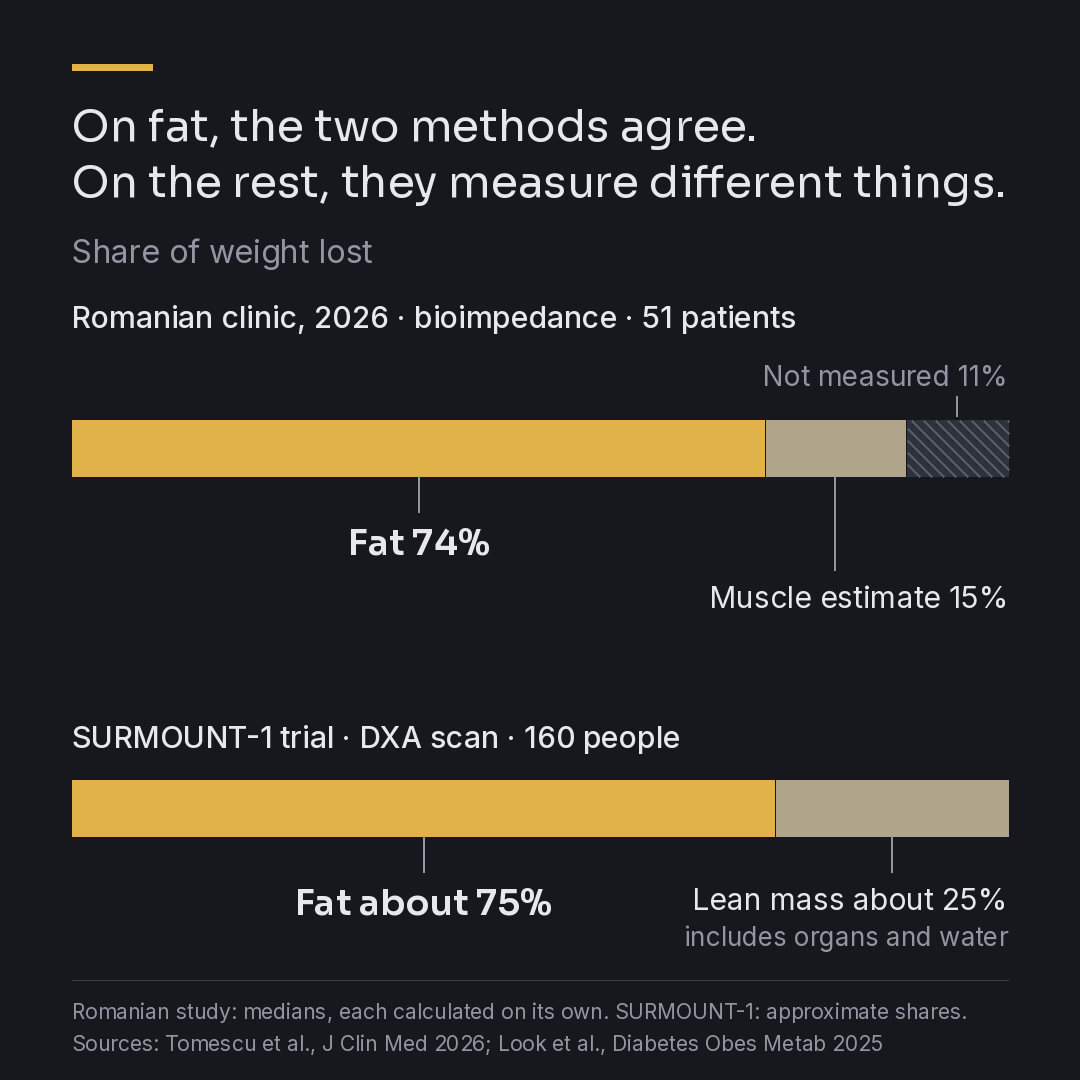
The device's estimate of muscle made up a median 15%, with the middle half between 12% and 21%. What remains, a median 11%, is arithmetic: the weight lost minus the two estimates, not a tissue anyone measured. The three medians were each calculated on their own and happen to add up to 100, but they are not a measured split of one body. One patient's estimated muscle loss came out at 111% of their total weight loss, a reminder that these numbers are device estimates, not anatomy.
Across all 59 patients, the median loss was 9.9 kilograms of estimated fat and 2.3 kilograms of estimated muscle, or 19.5% of each person's starting fat estimate and 6.6% of their starting muscle estimate. Those percentages answer a different question from the shares. The 74% and 15% divide by the weight lost and describe 51 people; the 19.5% and 6.6% divide by what each person had at the start and describe all 59.
Larger losses, larger drops in the muscle estimate
The bigger the weight loss, the bigger the drop in the muscle estimate. In the adjusted model, each additional 5 percentage points of weight lost came with 2.47 more percentage points of the starting muscle estimate gone (95% confidence interval 1.89 to 3.05). Because total weight includes muscle, part of that link is expected, as the authors note. It does not show that the drugs waste muscle, and it says nothing about whether function changed.
The sharper question is whether the device-estimated muscle share grows as people lose more. Here the study cannot decide. In the fully adjusted model, each additional 5 points of weight lost went with a share 0.52 points lower, with a 95% confidence interval running from 1.66 lower to 0.62 higher. Simpler models produced negative estimates with intervals below zero. The authors say that none of this shows the share stays stable, or that muscle function is preserved.
What the machine cannot see
The fat and muscle figures came from the InBody 770, which estimates body composition by bioimpedance, using prediction equations. Its readings move with hydration, and using the same device twice does not remove that. Records of hydration and recent exercise were not available. "Muscle" in this study is the device's estimate of skeletal muscle. It says nothing about strength or performance.
There was no untreated comparison group, so the changes cannot be separated from diet, activity, other care or time. The records held nothing on protein or energy intake, resistance training or whether people took the drug as prescribed: the two things a lifter would ask about first could not be accounted for. Only six patients took semaglutide, too few for reliable conclusions about that drug. And with a median BMI of 40.4 and no record of training, these results cannot establish what happens in lean, resistance-trained people.
A natural comparison is a DXA substudy of SURMOUNT-1, the main tirzepatide trial, where about 75% of the weight lost was fat mass and 25% was lean mass, in both the tirzepatide and placebo groups. On fat, the two point the same way. They cannot be compared directly. DXA lean mass includes tissues and water beyond skeletal muscle, and the two studies used different machines, different people and different follow-up. Six of that substudy's eight authors declared Eli Lilly employment and shares, and the other two declared financial relationships with the company.
What a record can add
Some of the gaps in this study are ones a personal record can add context to. Two scans are easier to interpret when they were taken the same way, on the same device, at the same time of day, in the same state of fasting, with those conditions written next to the result. A bioimpedance reading and a DXA scan are different measurements, not two points on one line. And what happened between the scans, the sessions, loads and sets, the protein and energy eaten, adds context only if it was written down with a date.
A dated log of loads and repetitions could add what these clinic records lacked: some sense of function. It would not measure muscle, and it would not prove what caused a change. What the Romanian study does show is narrower, and still worth knowing: among people who lost at least 5%, most of what came off was estimated fat. Whether the shrinking muscle estimate meant lost muscle, and what happened to anyone's strength, is the part this study never measured.
Sources
- Tomescu and colleagues, Journal of Clinical Medicine, 2026: body composition in 59 adults in routine obesity care doi.org
- Tomescu and colleagues, full text on PubMed Central pmc.ncbi.nlm.nih.gov
- Look and colleagues, Diabetes, Obesity and Metabolism, 2025: DXA substudy of the SURMOUNT-1 trial, 160 people pubmed.ncbi.nlm.nih.gov
For educational purposes only. Not medical advice.

Skinfold, bioimpedance and DXA, each reading compared only with its own method.
First month free for new subscribers.