
Cagrilintide 'maintained lean mass' in mice. Congress data: in a trial subgroup on it alone, 37% of weight lost was lean
A 2026 review of amylin drugs says that in recent animal work, cagrilintide "reduced food intake and body weight primarily through loss of fat mass while preserving lean tissue". The study it cites for that sentence treated male mice for three weeks, with eight assigned to each group. The mice did lose weight, but the differences in body composition against control mice given injections without the drug were not statistically significant.
In people, the closest measurement comes from body scans in a subgroup of the largest trial of the drug. In the group that took cagrilintide alone, 37.1% of the weight lost was lean soft tissue, according to results presented at two obesity congresses; our search of Europe PMC found no peer-reviewed paper reporting them. Lean soft tissue is not the same as muscle. None of this establishes what cagrilintide does to the muscle of a person who trains.
What cagrilintide is
Amylin is a hormone made in the pancreas. The review describes it as "co-secreted with insulin" from the beta cells, and says it slows the emptying of the stomach, holds back glucagon and acts in the brain to end a meal. A short-acting synthetic analogue, pramlintide, is used in diabetes alongside insulin, according to the 2021 paper in which Novo Nordisk chemists described their alternative.
That alternative is cagrilintide: a stable, long-acting version of amylin with a fatty chain attached. The review classes it as acting on both amylin and calcitonin receptors. Novo Nordisk has tested it on its own and as one half of CagriSema, a fixed combination with semaglutide, the drug behind Ozempic and Wegovy.
The mice behind the claim
The mouse study, published in eBioMedicine in 2025 by researchers at the University of Zurich and Novo Nordisk, was mainly about where in the brain the drug works. Male mice were fed high-fat diets for about five months and then treated for 21 days. Normal mice lost weight on cagrilintide, an average of 3.4 grams. Mice bred without two amylin receptor components did not respond the same way, which pointed to those receptors in the brain.
Fat and lean mass were measured with an MRI device after the animals were killed, so there is no before-and-after scan of each animal. The paper reports the results in grams and as a share of body weight, with seven to eight mice per group in the figure. In the normal mice, the authors write, the changes against control mice given injections without the drug "did not reach statistical significance", with fat mass decreasing by 7% and lean mass increasing by 5%, as shares of body weight. Their summary is that cagrilintide "seems to lower body weight by acting on fat depots while maintaining lean mass".
The drugs were supplied by Novo Nordisk, and the work was funded in part by a Novo Nordisk research grant. The paper states that three company employees had a consulting role in the study design and the interpretation of the data and approved the final manuscript, and that Novo Nordisk had no role in data collection or analysis.
A share of body weight can rise while the tissue itself shrinks, simply because fat leaves faster. That distinction comes back in the human data.
What the trials in people showed
The first large test of cagrilintide alone was a phase 2 trial published in The Lancet in 2021. It randomly assigned 706 adults with overweight or obesity to five cagrilintide groups, an older weight-loss drug or placebo, for 26 weeks. Assuming everyone stayed on treatment, weight fell by 6.0% to 10.8% across the cagrilintide groups, against 3.0% on placebo.
The decisive test came in REDEFINE 1, published in the New England Journal of Medicine in 2025. It enrolled 3,417 adults without diabetes for 68 weeks and assigned most of them to the combination: 2,108 to CagriSema, 302 to semaglutide alone, 302 to cagrilintide alone and 705 to placebo, all alongside diet and exercise advice. In the company's announcement, counting everyone regardless of whether they kept taking the drug, weight fell by 20.4% on the combination, 14.9% on semaglutide, 11.5% on cagrilintide and 3.0% on placebo. Gastrointestinal side effects such as nausea, vomiting, diarrhoea, constipation or abdominal pain affected 79.6% of people on the combination and 39.9% on placebo, and were mainly transient and mild to moderate, according to the journal report. The trial was funded by Novo Nordisk.
What the scans in REDEFINE 1 showed
Of the REDEFINE 1 participants, 252 had a DXA scan, a low-dose X-ray that divides the body into fat, bone and lean soft tissue. Eric Ravussin of the Pennington Biomedical Research Center presented the results at ObesityWeek in November 2025 and at the European Congress on Obesity in May 2026. The analysis left out bone and described the weight lost as fat and lean soft tissue. The subgroup figures assume everyone took the treatment as intended, and the subgroup is a smaller population, so its weight losses differ from the whole-trial results above. The handout of the ObesityWeek poster was behind a login and we could not read it.
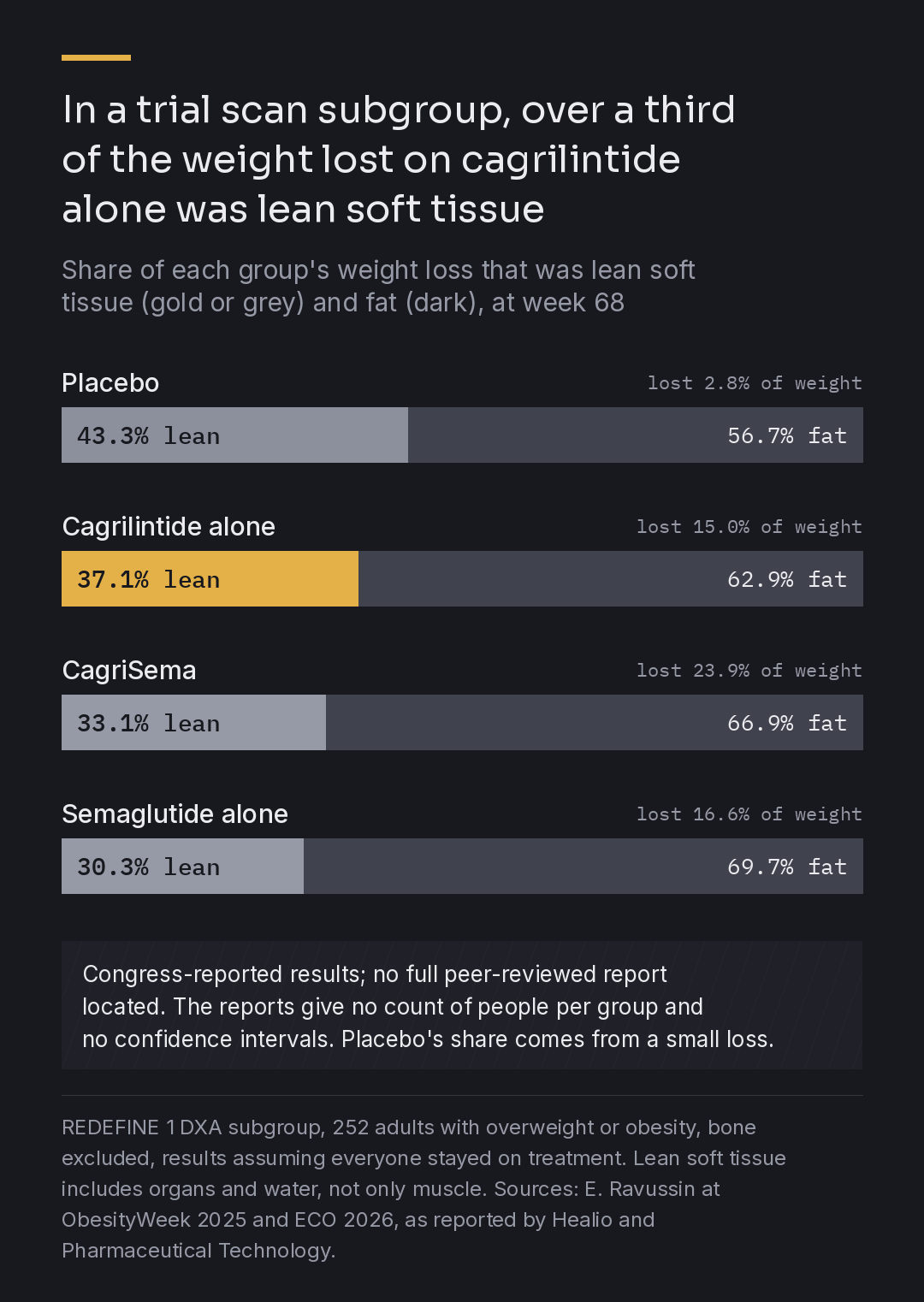
On the combination, 66.9% of the weight lost was fat and 33.1% lean soft tissue. On semaglutide alone the lean share was 30.3%, on cagrilintide alone 37.1% and on placebo 43.3%, where people lost little weight. Among the three drug groups, the one that took only cagrilintide had the highest lean share. These are descriptive percentages, without a count of people per group or a measure of uncertainty in the reports: they do not establish that cagrilintide preserves lean tissue better than semaglutide, nor that it preserves less. In the trial as a whole, cagrilintide alone was assigned to 302 of 3,417 participants, fewer than one in eleven.
The presentations stressed a different number. Among people who lost 30% or more of their weight on the combination, lean soft tissue rose from 51.3% of body weight at the start to 63.2% at week 68. As in the mice, that is a share. The ECO report says that "an overall absolute reduction in lean soft tissue was observed" on the combination.
Lean soft tissue also counts organs and water, not only muscle. Strength was measured with a sit-to-stand test in about a thousand participants, and improvements on the combination were similar to placebo. "Basically there was no loss of strength," Ravussin said, according to Healio. People on the combination also reported greater improvements in physical function on questionnaires than those on placebo. A sit-to-stand test measures getting out of a chair, not what a lifter can move.
For context, a scan substudy of SURMOUNT-1, the main tirzepatide trial, found that about 25% of the weight lost was lean mass, in both the drug and placebo groups, as we described in our article on GLP-1 drugs and lean mass. The two cannot be compared directly: different people, different drugs, different analyses, and only the SURMOUNT-1 body-composition results have a peer-reviewed paper identified here.
Against tirzepatide
In REDEFINE 4, Novo Nordisk compared CagriSema with tirzepatide, sold as Zepbound and Mounjaro, in 809 adults with obesity for 84 weeks. The trial was open-label: everyone knew which drug they were on. According to the company's announcement of 23 February 2026, weight fell by 20.2% on CagriSema and 23.6% on tirzepatide, counting everyone regardless of whether they stayed on treatment. The trial did not meet its main goal, which was to show that CagriSema was not unacceptably less effective than tirzepatide. More on that drug is in our tirzepatide article.
Where the rules stand
Our search of the FDA's drug approvals database on 10 November 2026 found no approval record for cagrilintide, alone or in combination. In the February 2026 announcement, Novo Nordisk said CagriSema was submitted to the FDA in December 2025 and that a decision "is anticipated by late 2026".
The World Anti-Doping Agency's 2026 Prohibited List does not name cagrilintide. Its first class, S0, prohibits at all times any pharmacological substance that is not addressed elsewhere on the list and has no current approval from any government health authority for human therapeutic use. A substance does not need to be named for that rule to apply.
What is still missing
The review's lean-sparing sentence cites a three-week experiment in male mice, in which the body composition differences were not statistically significant. The human sources here report a scan subgroup through congress presentations, with no count per group and no measure of uncertainty. None of them measures skeletal muscle or strength under load in people who train. Until that evidence exists, the idea that cagrilintide spares muscle is a hypothesis.
Sources
- Carvas and colleagues, eBioMedicine, 2025: cagrilintide lowers bodyweight through brain amylin receptors 1 and 3 (mouse study) doi.org
- Alhazmi and le Roux, Diabetes, Obesity and Metabolism, 2026: amylin analogs, a review of experimental data and early-phase trials doi.org
- Kruse and colleagues, Journal of Medicinal Chemistry, 2021: development of cagrilintide, a long-acting amylin analogue doi.org
- Lau and colleagues, The Lancet, 2021: cagrilintide for weight management, a dose-finding phase 2 trial doi.org
- Garvey and colleagues, New England Journal of Medicine, 2025: coadministered cagrilintide and semaglutide (REDEFINE 1) doi.org
- Novo Nordisk company announcement, 20 December 2024: REDEFINE 1 headline results novonordisk.com
- Healio, 6 November 2025: REDEFINE 1 body composition and physical function results presented at ObesityWeek healio.com
- Pharmaceutical Technology, May 2026: REDEFINE 1 body composition results presented at the European Congress on Obesity pharmaceutical-technology.com
- Novo Nordisk company announcement, 23 February 2026: REDEFINE 4 headline results against tirzepatide novonordisk.com
- World Anti-Doping Agency, 2026 Prohibited List wada-ama.org
For educational purposes only. Not medical advice.

Skinfold, bioimpedance and DXA, each reading compared only with its own method.
First month free for new subscribers.