
Retatrutide: what the trials show, and what is sold outside them
In October 2026, doctors in Zürich published the case of a woman in her mid-20s who came to hospital after five days of nausea and vomiting. Blood tests, a urine test, an abdominal ultrasound and a brain MRI found no other cause. Only repeated, non-judgemental questioning about what she had taken brought it out: four weekly injections, given by a self-described life coach, of an unverified product said to contain retatrutide. She had not considered the injections medication. Two days after admission she began to improve, and within a week the symptoms were gone. The authors judged the link to the injections probable.
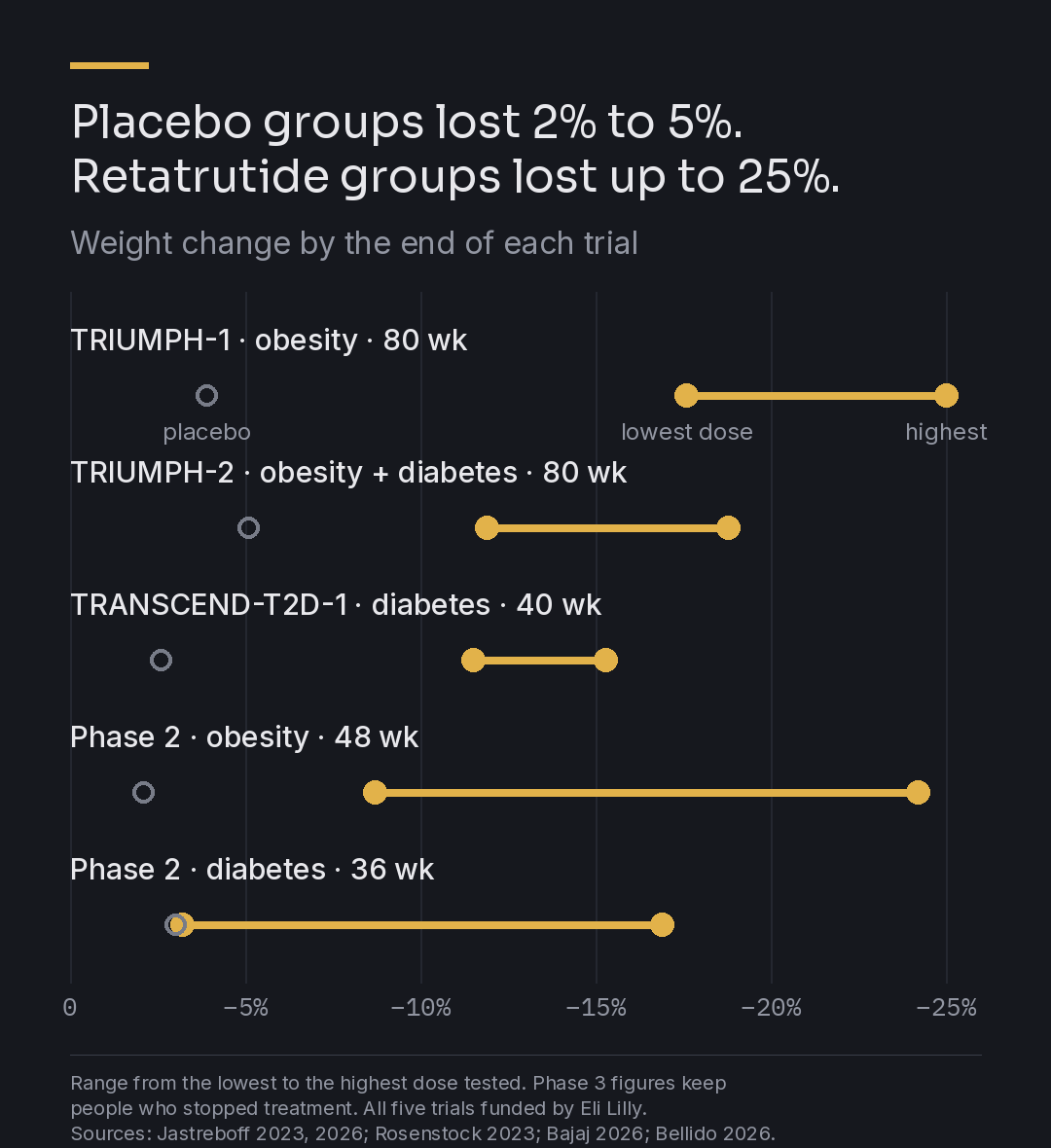
Retatrutide is still an investigational drug, made by Eli Lilly and not approved by the FDA. In Lilly's trials it produced average weight losses of up to a quarter of body weight. Those numbers have travelled well beyond the trials, and products sold as retatrutide are already being injected outside them. So retatrutide now reaches people in two ways: as trial medication given under supervision, and as products sold online whose contents vary. This piece maps what is known about both, as of 4 November 2026.
Three receptors at once
Retatrutide acts on three hormone receptors: GIP, GLP-1 and glucagon. Semaglutide acts on one of them and tirzepatide on two. In the trials it was given as a once-weekly injection.
What the trials found
We found five phase 2 and phase 3 trials published in full by 4 November 2026. Together they randomized 4,647 people, counting those given placebo, and all five were funded by Eli Lilly. Smaller earlier studies are not included here, and neither are results that Lilly has announced only by press release.
| Trial | Who took part | People | Weeks |
|---|---|---|---|
| Phase 2, NEJM 2023 | Obesity, or overweight with a related condition, no diabetes | 338 | 48 |
| Phase 2, Lancet 2023 | Type 2 diabetes | 281 | 36 |
| TRANSCEND-T2D-1, Lancet 2026 | Type 2 diabetes managed by diet and exercise alone | 537 | 40 |
| TRIUMPH-2, Lancet 2026 | Obesity or overweight with type 2 diabetes | 1,152 | 80 |
| TRIUMPH-1, NEJM 2026 | Obesity, no diabetes | 2,339 | 80 |
In the chart, each gold line runs from the lowest to the highest dose tested in that trial. The phase 3 weight figures keep people in the analysis after they stopped treatment and estimate the outcomes that are missing, rather than counting only those who completed it.
The largest trial, TRIUMPH-1, also looked beyond the scale. Among its 574 participants with knee osteoarthritis, knee pain fell more on retatrutide than on placebo. And in two sleep apnea trials nested inside TRIUMPH-1 and TRIUMPH-2, in people with moderate to severe apnea, breathing interruptions during sleep fell substantially more on retatrutide than on placebo over 80 weeks.
The question lifters ask
How much of that weight was fat? The published evidence is limited. One substudy scanned participants of the phase 2 diabetes trial by DXA: 189 were enrolled, and 103 completed treatment with a scan at the start and another at week 36. Measured while people stayed on treatment, total fat mass fell by 15.2% to 26.1% in the three higher dose groups, against 4.5% on placebo. Those percentages describe the change from each person's starting fat mass; the published summary does not give the share of total weight lost that was fat, and the analysis covers people while they stayed on treatment, not everyone randomized. The authors write that the share of the weight lost that came from lean mass was similar to other obesity treatments.
That sentence carries three caveats. DXA lean mass is not muscle: it includes organs and water (we covered why here). The substudy covered people with diabetes over 36 weeks. And all seven of its authors declared that they are Eli Lilly employees and shareholders. We found no published body composition result from the phase 3 trials, and no results for people who start lean and train.
The cost
The authors of TRIUMPH-2 describe the side effects as generally consistent with other drugs that act on GLP-1, and the numbers in their published summary show what that means. Diarrhoea affected 27% to 34% of people on retatrutide, depending on dose, against 13% on placebo, and nausea 14% to 28% against 8%. Two other effects were also more common than with placebo: dysesthesia, an abnormal sensation in the skin, in 4% to 7% against 1%, and low blood pressure in 1% to 6% against under 1%. Between 4% and 12% stopped treatment because of an adverse event or death, against 5% on placebo. Six people died across the three retatrutide groups and one in the placebo group, and the investigators judged none of the deaths to be related to the drug. In the phase 2 obesity trial, heart rate rose with dose, peaked at week 24 and then declined.
The other retatrutide
None of this tells you what is in a vial bought online, and this year three reports looked outside the trials.
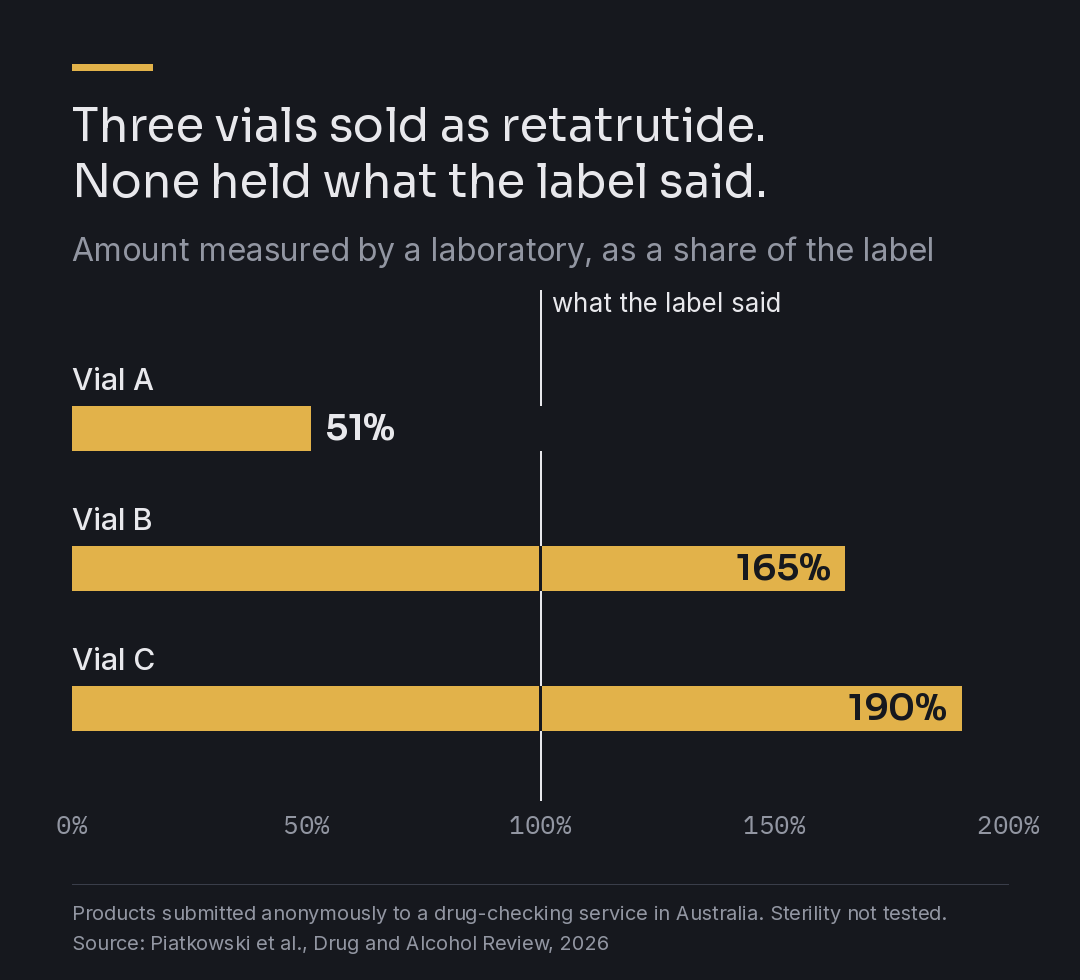
In Australia, people submitted three products sold as retatrutide to a community drug-checking service, which sent them to an accredited laboratory. All three contained retatrutide. The amount, though, ranged from 51% of what the label promised to 190%. They were not tested for sterility or bacterial endotoxins. Three samples cannot describe a market, and the authors say so.
Researchers in Philadelphia read Reddit posts from May 2021 to December 2025. They found 13,589 users saying they took retatrutide and analyzed the 7,823 who described symptoms. The symptom described most often was not nausea but increased appetite, mentioned by 17.1% of them, followed by fatigue at 15.2%, increased energy at 12.4% and nausea at 11.6%. A faster heart rate came up in 4.8%. These are self-reports from people who chose to post, not rates among everyone who uses it, and the researchers could not verify the products used.
And then there is the woman in Zürich, whose injections came to light only after her doctors kept asking.
Where it stands
FDA. The agency lists retatrutide among unapproved drugs that "have not been found safe and effective for any condition" and that cannot be used in compounding. When Lilly reported topline results from two more phase 3 trials on 23 July 2026, including TRIUMPH-3 in 1,949 adults with a BMI of 35 or more and established cardiovascular disease, the company said it plans to submit its application in the first quarter of 2027. TRIUMPH-3 has not yet been published in full.
WADA. Retatrutide is not named on the 2026 Prohibited List, and the list does not mention GLP-1 or glucagon anywhere. Its section S0 prohibits at all times "any pharmacological substance which is not addressed by any of the subsequent sections of the List and with no current approval by any governmental regulatory health authority for human therapeutic use (e.g. drugs under pre-clinical or clinical development...)". We found no WADA decision applying that rule to retatrutide by name, so we do not classify it here.
Testing. A Brazilian anti-doping laboratory developed a method to find it in both plasma and urine, then followed four people who injected it on days 1 and 7. It was detectable in their blood plasma for about 56 days after the first injection. Neither the drug nor its breakdown products were detected in their urine.
What would change the picture
TRIUMPH-3 and the other phase 3 trials published in full. Body composition measured by DXA across a phase 3 trial, not only in a 36-week substudy. Outcomes beyond weight, such as heart attacks, strokes and deaths, followed for years. And any data at all on people who start lean and train.
The open question
The largest trial reported an average loss of a quarter of starting body weight in its highest dose group. For someone who trains, that number leaves the question that matters most to them unanswered: what the loss means for muscle and for strength. The only body composition data come from a shorter study in people with diabetes, measured by a method whose "lean mass" lumps muscle together with water and organs. And the woman in Zürich is a reminder of the other gap. In the trials, the drug came from its manufacturer. Outside them, in the three vials an Australian laboratory tested, the amount ranged from half of what the label said to almost double.
Sources
- Jastreboff and colleagues, NEJM, 2023: phase 2 trial in obesity, 338 people doi.org
- Rosenstock and colleagues, Lancet, 2023: phase 2 trial in type 2 diabetes, 281 people doi.org
- Coskun and colleagues, Lancet Diabetes and Endocrinology, 2025: DXA body composition substudy of the phase 2 diabetes trial doi.org
- Bajaj and colleagues, Lancet, 2026: TRANSCEND-T2D-1, 537 people with type 2 diabetes doi.org
- Bellido and colleagues, Lancet, 2026: TRIUMPH-2, 1,152 people with obesity and type 2 diabetes doi.org
- Jastreboff and colleagues, NEJM, 2026: TRIUMPH-1, 2,339 people with obesity doi.org
- Grunstein and colleagues, NEJM, 2026: sleep apnea trials nested in TRIUMPH-1 and TRIUMPH-2 doi.org
- Piatkowski and colleagues, Drug and Alcohol Review, 2026: laboratory test of three products sold as retatrutide in Australia pmc.ncbi.nlm.nih.gov
- Sehgal and colleagues, JAMA Network Open, 2026: symptoms described by Reddit users of nonapproved retatrutide pmc.ncbi.nlm.nih.gov
- Buzzi and Huber, BMJ Case Reports, 2026: hospital admission after injections of an unverified product doi.org
- Carneiro and colleagues, Rapid Communications in Mass Spectrometry, 2026: anti-doping method validated in plasma and urine; detection in plasma only doi.org
- HCPLive, 23 July 2026: Lilly's TRIUMPH-2 and TRIUMPH-3 topline results and planned FDA submission hcplive.com
- US Food and Drug Administration, FDA's concerns with unapproved GLP-1 drugs used for weight loss (content current as of 1 October 2026) fda.gov
- World Anti-Doping Agency, 2026 Prohibited List, section S0 wada-ama.org
For educational purposes only. Not medical advice.
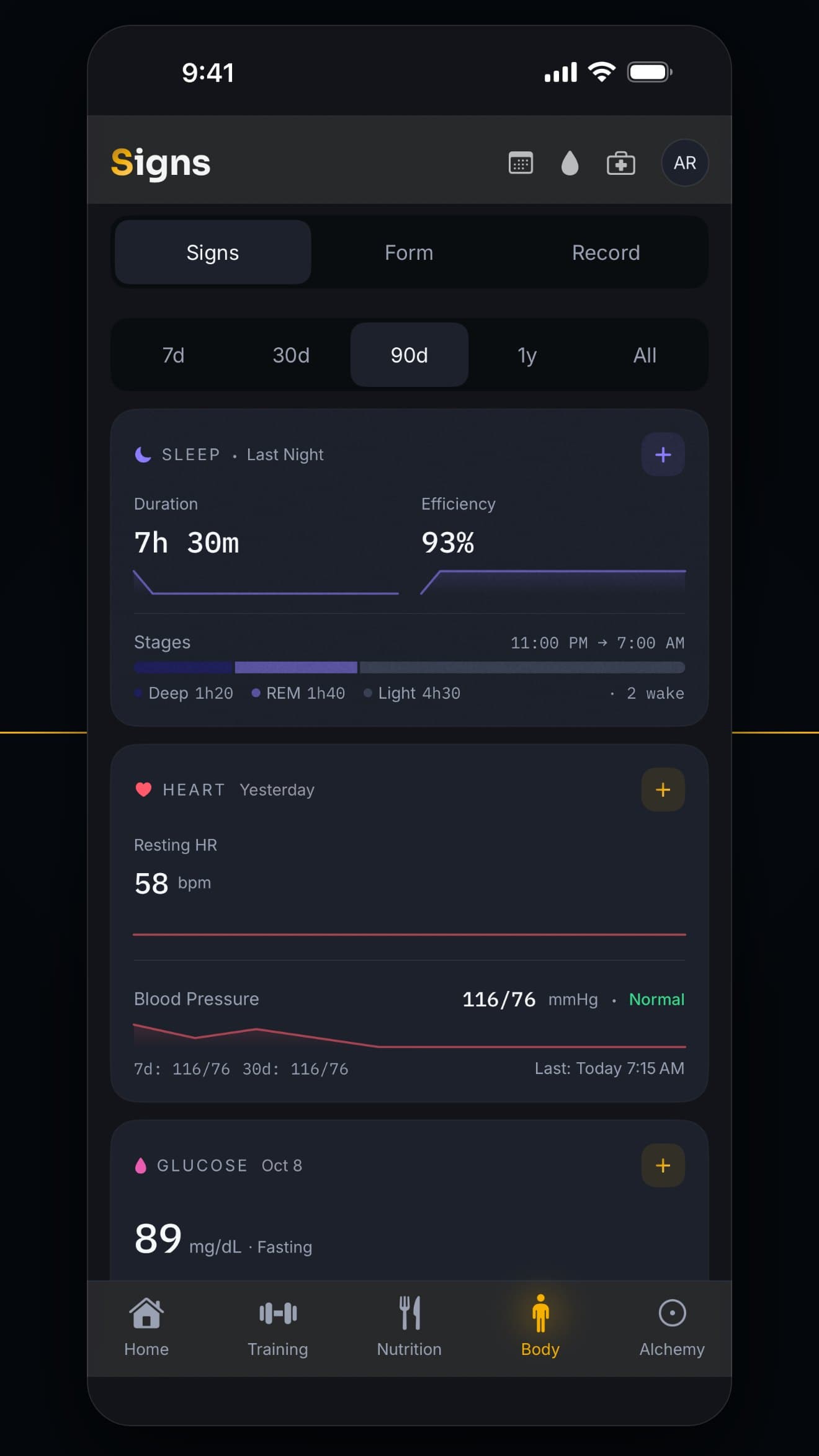
Sleep, heart rate, blood pressure and glucose, read in one place.
First month free for new subscribers.