
Tesamorelin cut deep belly fat in its HIV trials, with no clear effect on weight
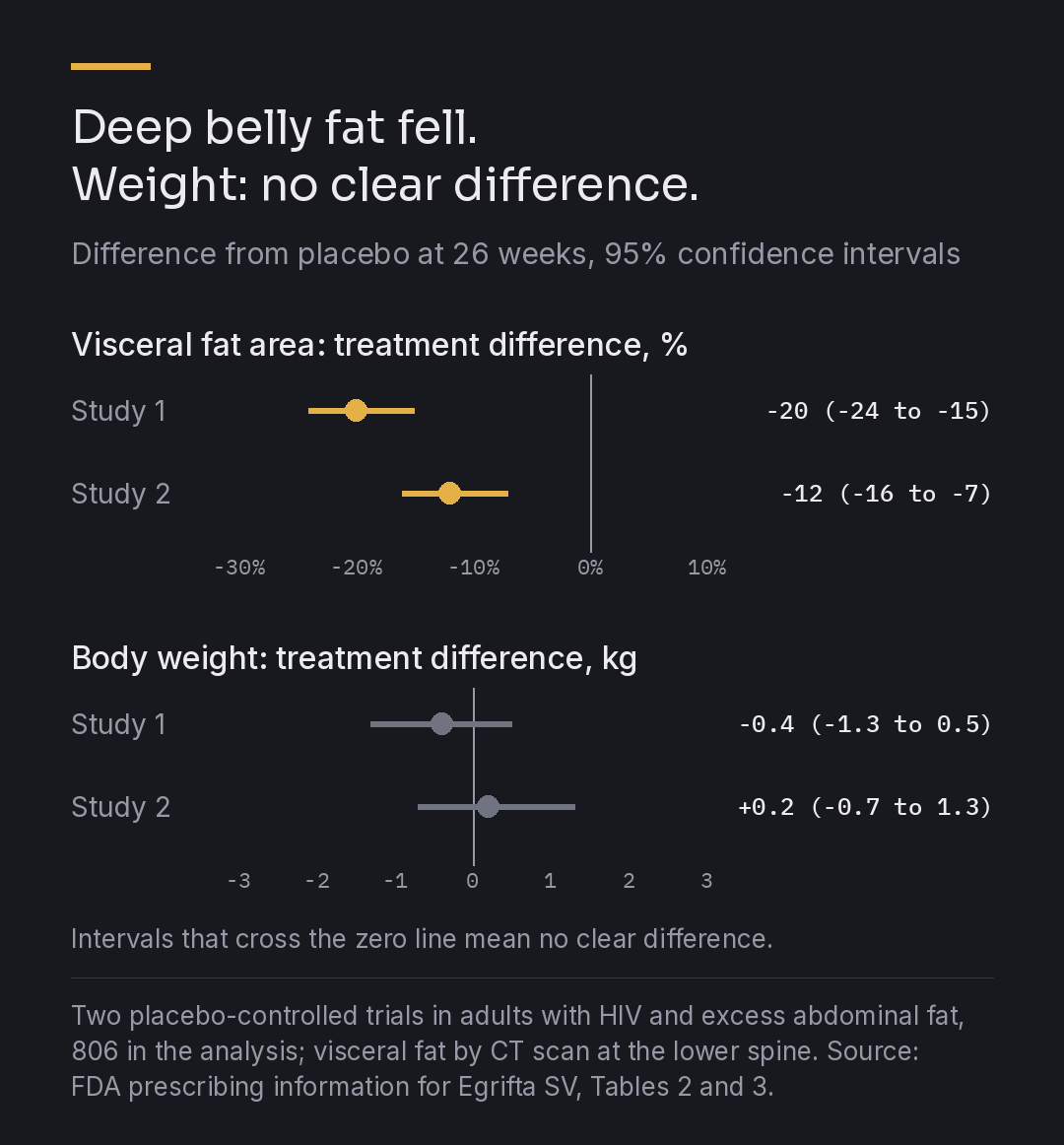
In the two placebo-controlled trials that led to its approval, all in adults with HIV and excess abdominal fat, tesamorelin reduced the fat packed around the abdominal organs by 15.4% more than placebo over 26 weeks, in a pooled analysis of 806 people. Body weight showed no clear difference from placebo in either trial. The drug's US prescribing information puts it plainly: tesamorelin "is not indicated for weight loss management as it has a weight neutral effect."
That gap between a smaller waistline and a scale that barely moves is the first thing to understand about tesamorelin. The second is who was studied. The approval trials enrolled adults with HIV, lipodystrophy and excess abdominal fat who were receiving antiretroviral treatment. What the drug does in a healthy person who trains was not what those trials were built to answer.
What the trials measured
Both phase 3 trials measured the area of visceral fat on a CT scan at the level of the lower spine. Reported separately on the label, the treatment differences were −20% in the first trial (95% confidence interval −24 to −15) and −12% in the second (−16 to −7). Fat just under the skin of the abdomen did not change significantly. Waist circumference fell by 1 to 2 centimetres more than with placebo.
The body composition data help explain the scale. From baseline, trunk fat in the tesamorelin groups fell by 1.0 kg and 0.8 kg in the two trials, while lean body mass rose by 1.3 kg and 1.2 kg, against little change on placebo. Fat and lean mass moved in opposite directions, which helps explain why weight changed little. A 2026 meta-analysis pooling five randomised trials put the lean mass difference versus placebo at 1.42 kg. An exploratory secondary analysis compared people whose visceral fat had responded to tesamorelin with placebo participants and found small increases in the area and density of trunk muscles on CT. None of this establishes greater strength or better athletic performance.
The trials had real attrition: 80% and 74% of participants completed the first 26 weeks, and the label's analyses carried each person's last measurement forward when later ones were missing.
Smaller trials have looked at the liver. In a 2014 trial of 50 adults with HIV and abdominal fat accumulation at Massachusetts General Hospital, liver fat fell more with tesamorelin than with placebo. In a 2019 trial that enrolled 61 people with HIV and fatty liver disease, the estimated treatment difference in liver fat fraction after 12 months was −4.1 percentage points (95% confidence interval −7.6 to −0.7), corresponding to a 37% relative reduction from baseline, and 35% of those on the drug, against 4% on placebo, ended below the 5% threshold used to define the condition. These are imaging results; they do not establish fewer cardiovascular events or any gain in performance.
What happened when it stopped
In the extension phases, participants who had completed the first 26 weeks on tesamorelin were re-randomised to continue or switch to placebo. Over the following 26 weeks, visceral fat rose by 22% and 16% from its week-26 level in the groups switched to placebo, according to the label. A 2008 report on the first trial put it directly: "Upon discontinuation of tesamorelin, VAT reaccumulated."
What the label warns about
Most of the warnings follow from the hormone it releases. Among patients treated for 26 weeks, 47% had IGF-1 standard deviation scores above +2 and 36% above +3. The label says the effects of prolonged IGF-1 elevation "are unknown."
Glucose is the second concern. HbA1c at or above 6.5% appeared in 5% of treated patients and 1% of those on placebo by week 26, and the label reports a higher risk of developing diabetes than with placebo. A separate 12-week trial in 53 people with type 2 diabetes found no significant differences between groups in fasting glucose, HbA1c or overall diabetes control. That smaller, shorter study does not cancel the warning drawn from the larger trials.
The label also lists fluid retention, joint and muscle pain, carpal tunnel syndrome, hypersensitivity reactions (seen in 4% of treated patients) and injection-site reactions. The drug is contraindicated in active cancer and in pregnancy, and its long-term cardiovascular safety "has not been established."
A signal to release the body's own growth hormone
Tesamorelin is a synthetic version of growth hormone-releasing hormone, the 44-amino-acid peptide the hypothalamus uses to tell the pituitary gland to release growth hormone, with a short fatty chain added at one end. According to the label, it binds the same receptor as the natural hormone, with similar potency in laboratory tests.
That makes it different from injected growth hormone. Tesamorelin does not supply the hormone; it prompts the pituitary to release more of the body's own, which in turn raises IGF-1, the growth factor through which many of growth hormone's effects run. The label reports no clinically significant changes in other pituitary hormones, including thyroid-stimulating hormone, luteinising hormone and prolactin.
The US Food and Drug Administration approved it on 10 November 2010, under the brand name Egrifta, made by the Canadian company Theratechnologies. Its single indication is the reduction of excess abdominal fat in adults with HIV and lipodystrophy.
What these trials cannot tell someone who trains
The approval trials enrolled people with HIV-related fat redistribution, on average 48 years old and mostly men, with waists above set thresholds. Whether the same effects appear in a lean, healthy person who trains is not something these data address. A protocol published in July 2026 describes TRIUMPH, a planned trial combining tesamorelin with exercise in 100 sedentary adults aged 50 to 80 with HIV, excess abdominal fat, and frailty or risk of frailty; it reports the design, not results.
Under the World Anti-Doping Agency's 2026 rules, tesamorelin is prohibited both in and out of competition, named among the growth hormone-releasing factors in section S2.2.4.
What the evidence shows is narrow and carefully measured: in the population studied, tesamorelin moved fat off the CT scan rather than off the scale, and visceral fat came back after it was withdrawn.
Sources
- FDA prescribing information for Egrifta SV (tesamorelin for injection), openFDA record effective 29 July 2026, via DailyMed dailymed.nlm.nih.gov
- Drugs@FDA, application 022505 (Egrifta), original approval 10 November 2010 accessdata.fda.gov
- Falutz et al., pooled analysis of two phase 3 trials of tesamorelin, Journal of Clinical Endocrinology and Metabolism, 2010 doi.org
- Falutz et al., long-term safety and effects of tesamorelin, AIDS, 2008 doi.org
- Stanley et al., effect of tesamorelin on visceral fat and liver fat, JAMA, 2014 doi.org
- Stanley et al., tesamorelin in non-alcoholic fatty liver disease in HIV, Lancet HIV, 2019 doi.org
- Clemmons et al., tesamorelin in type 2 diabetes, PLOS One, 2017 doi.org
- Adrian et al., tesamorelin, muscle fat and muscle area in adults with HIV, Journal of Frailty and Aging, 2019 doi.org
- Badran et al., meta-analysis of randomised trials of tesamorelin, Obesity Research and Clinical Practice, 2026 doi.org
- Ditta et al., systematic review and meta-analysis of tesamorelin, Journal of the International Association of Providers of AIDS Care, 2026 doi.org
- Erlandson et al., TRIUMPH trial protocol: tesamorelin as an adjunct to exercise, BMJ Open, 2026 doi.org
- World Anti-Doping Agency, Prohibited List 2026, section S2.2.4 wada-ama.org
For educational purposes only. Not medical advice.
Skinfold, bioimpedance and DXA, each reading compared only with its own method.
First month free for new subscribers.