
TB-500 and thymosin beta-4: different molecules, different evidence
In a rat study published in July, orthopaedic surgeons in Istanbul repaired the Achilles tendons of 32 animals and assigned them to BPC-157, TB-500, both, or a control group. The abstract describes the second compound as "synthetic thymosin beta-4 (TB-500)" and does not give its amino acid sequence. The US Food and Drug Administration, in a briefing prepared for its July 2026 advisory committee meeting, is explicit that the two are not the same: "thymosin beta-4 and TB-500 are not the same substance."
That gap is the first thing to know. None of the human trials reviewed here shows a benefit for a training injury. The human trials that exist were run with the full protein, mostly as eye drops. The FDA found no human studies of the fragment it calls TB-500. And the tendon result people cite comes from rats given a compound whose identity the abstract does not settle.
Different molecules, one confusion
Thymosin beta-4 is a protein of 43 amino acids that the body makes itself. Among other things, it binds actin, the protein that lets cells change shape and move, which is why it has been studied in wound healing.
The FDA describes TB-500 as "a seven amino acid synthetic fragment of thymosin beta-4 (β4) from amino acids 17 to 23," with an acetyl group added at the start: Ac-LKKTETQ. Researchers at the Hong Kong Jockey Club, writing about horse racing in 2012, described a veterinary preparation known as TB-500 whose key ingredient was that acetylated fragment, and a Belgian anti-doping laboratory identified the fragment in a TB-500 product the same year. The acetyl group matters: the FDA cautions that findings for the unacetylated sequence "cannot be directly extrapolated" to TB-500.
The agency also notes that several websites call TB-500 a synthetic version of thymosin beta-4 and "often use the terms interchangeably." TB-500 is a common name, not an official drug name, and the FDA wrote that it has "encountered multiple salts, and derivatives, including different active moieties, sold commercially under the same common name," which it called a safety risk. When a French horse-racing laboratory analysed products sold online as TB500 and TB1000 in 2023, it reported that their content was "not systematically consistent" with how they had been described.
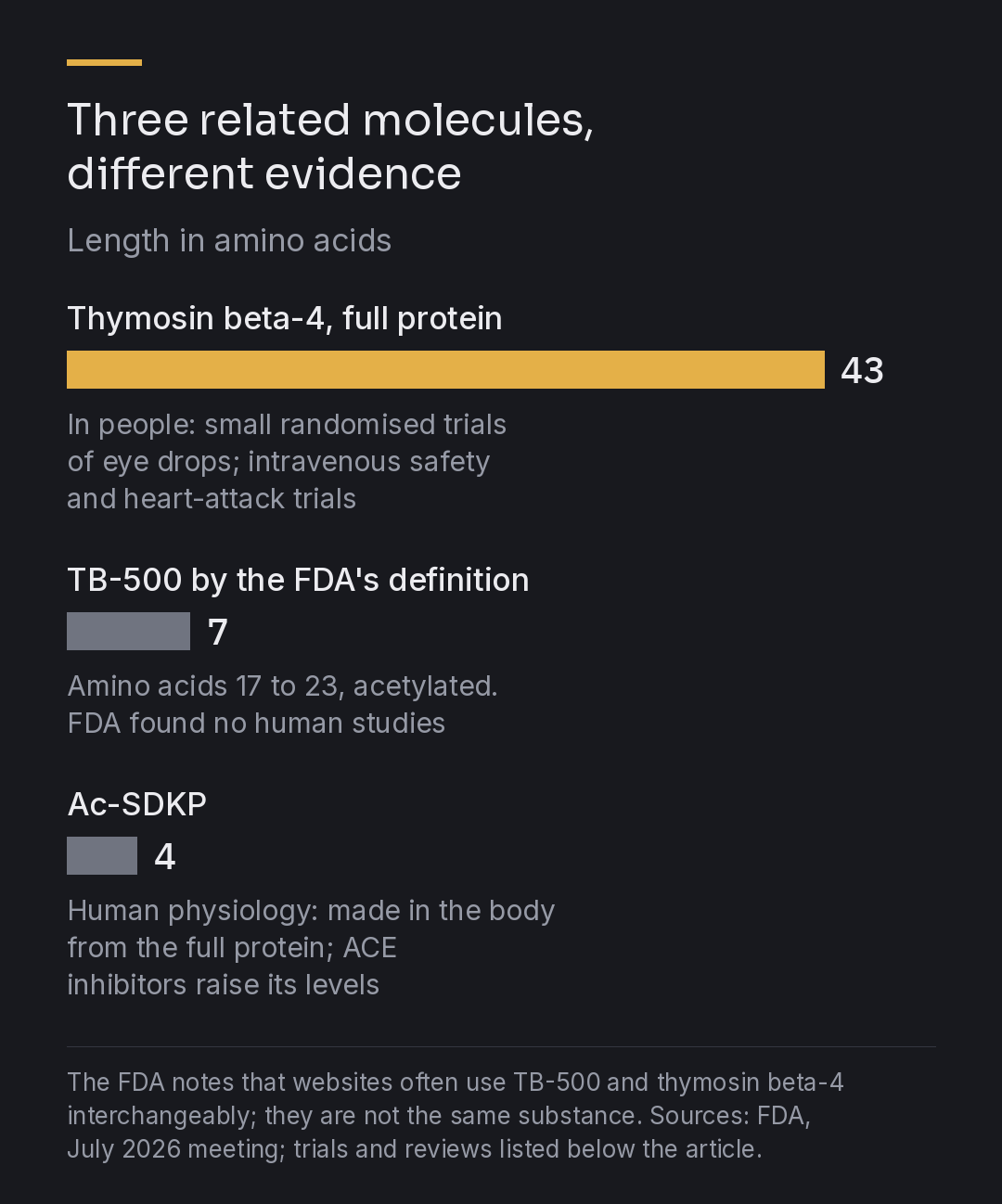
A third relative completes the picture. Ac-SDKP, four amino acids long, is released from thymosin beta-4 inside the body by enzymes including prolyl oligopeptidase and meprin-alpha, and broken down by ACE. Studies of ACE inhibitors, a common class of blood pressure drugs, have found higher Ac-SDKP levels in people taking them.
The full protein has been tested in people
Thymosin beta-4 itself has a modest human record, and most of it is in the eye. In a phase 2 trial of 72 people with moderate to severe dry eye, neither primary endpoint, discomfort and staining of the lower cornea, differed significantly from placebo; several secondary measures did. In a smaller phase 2 trial in severe dry eye, with nine patients, the treated group reported less discomfort and showed less surface damage than the control group at day 56. In a phase 3 trial in neurotrophic keratopathy, a condition in which the cornea fails to heal, complete healing at four weeks occurred in 6 of 10 treated patients and 1 of 8 on placebo, a difference that was not statistically significant. That trial was designed in part by employees of ReGenTree, LLC.
Given intravenously, a recombinant version was tested for safety in a first-in-human phase 1 study, with employees of the sponsor among its authors, in 54 healthy people given a single dose and 30 given repeated doses. Adverse events were mild to moderate, with no serious ones. In a 2025 trial of 96 patients treated after a heart attack, the overall difference in infarct size at 90 days between the recombinant protein and placebo was not statistically significant. The authors reported a reduction in a subgroup defined by the timing of treatment after the coronary procedure; the abstract does not say whether that analysis was planned in advance.
None of these trials studied a muscle or tendon injury, and none used the seven-amino-acid fragment.
The FDA found no human studies of the fragment
For TB-500 as it defines it, the FDA's review is direct: the agency "did not find any information in the medical literature where TB-500 was administered to patients to treat any disease or condition." It also found no human studies of how the fragment is absorbed and cleared.
What it did find is mostly laboratory work. In one fibroblast scratch assay, a test of how quickly cells close a gap, wound closure was not significantly different between TB-500 and the control, while a smaller acetylated piece that TB-500 breaks down into appeared to improve closure. Studies in animals show that the fragment reaches the bloodstream after injection and is broken down into smaller peptides. The agency did not identify animal studies of whether it promotes wound healing.
The rat Achilles study is the kind of evidence that circulates instead. With eight animals assigned to each group, the group given the compound it calls TB-500 showed a statistically significant advantage in the force needed to break the repaired tendon after four weeks, and better tissue scores than controls. The study detected no additional benefit from combining it with BPC-157. The authors call their findings preliminary, from an exploratory model.
The FDA's safety concerns follow from the missing data. It warned that injected peptides "may pose a significant risk for immunogenicity, potentially amplified by aggregation as well as potential peptide-related impurities," and that it identified no clinical studies assessing immunogenicity or aggregation of TB-500. In the agency's words, the potential safety risks of these substances in humans "are unknown."
Where the rules stand
Neither the FDA-defined fragment nor its acetate salt is a component of an FDA-approved drug, and the FDA's briefing found no approved TB-500 products in the other countries it surveyed, including Canada, Australia, the United Kingdom and several European Union members, nor any authorised by the European Medicines Agency.
The FDA's page on bulk substances that may pose safety risks in compounding, current as of 22 April 2026, lists the fragment among nominations that were withdrawn, and says the FDA "has not identified any human exposure data" for it. The agency then evaluated the fragment and its acetate salt on its own initiative, for wound healing, and recommended against adding either to the section 503A bulk drug substances list, which governs what US pharmacies may compound. At the advisory committee meeting on 23 July 2026, the panel recommended inclusion by 8 votes to 6, with one abstention, under a combined heading for both forms, according to a summary by the law firm McDermott Will & Schulte. The vote does not bind the FDA, which said it would not make a final determination until the committee's input and its reviews were complete.
In sport there is no ambiguity. The World Anti-Doping Agency's 2026 Prohibited List names "Thymosin-ß4 and its derivatives e.g. TB-500" among the growth factors in section S2, which is prohibited at all times, in and out of competition.
What would settle it
The list is longer than one trial. It starts with a chemically defined product, so that a paper, a clinic or a forum says which molecule it means. It continues with safety and pharmacokinetic studies in people, and ends with controlled trials in the injury being claimed. None of the human trials reviewed here shows a benefit for a training injury, and as long as one name covers different molecules, evidence for one cannot be borrowed for the other.
Sources
- FDA briefing document on TB-500 (free base) and TB-500 acetate, Pharmacy Compounding Advisory Committee, July 2026 fda.gov
- FDA, bulk drug substances that may present significant safety risks, withdrawn-nominations section, page current as of 22 April 2026 fda.gov
- McDermott Will & Schulte, 27 July 2026: PCAC vote results on seven peptides mcdermottlaw.com
- World Anti-Doping Agency, Prohibited List 2026, section S2 wada-ama.org
- Achilles tendon repair in rats with BPC-157 and TB-500, Joint Diseases and Related Surgery, 2026 doi.org
- Doping control analysis of TB-500 in equine urine and plasma, Journal of Chromatography A, 2012 doi.org
- Identification of the acetylated 17-23 fragment of thymosin beta-4 in TB-500, Drug Testing and Analysis, 2012 doi.org
- Analysis of products sold online as TB500, TB1000 and SGF1000, Drug Testing and Analysis, 2023 doi.org
- Phase 3 trial of thymosin beta-4 eye drops in neurotrophic keratopathy, International Journal of Molecular Sciences, 2022 doi.org
- Phase 2 trial of thymosin beta-4 eye drops in 72 people with moderate to severe dry eye, Clinical Ophthalmology, 2015 pubmed.ncbi.nlm.nih.gov
- Phase 2 trial of thymosin beta-4 eye drops in severe dry eye, Cornea, 2015 doi.org
- First-in-human phase 1 study of intravenous recombinant thymosin beta-4, Journal of Cellular and Molecular Medicine, 2021 doi.org
- Recombinant thymosin beta-4 in mice and in patients with acute myocardial infarction, Cardiovascular Research, 2025 doi.org
- Ac-SDKP: synthesis, role in ACE inhibition and therapeutic potential, review, 2018 pubmed.ncbi.nlm.nih.gov
- The thymosin beta-4, prolyl oligopeptidase and Ac-SDKP axis in organ fibrosis, review, 2022 pubmed.ncbi.nlm.nih.gov
For educational purposes only. Not medical advice.
Every set as lifted, drop sets and myo-reps included.
First month free for new subscribers.