
Sermorelin was approved for children with growth failure. Its small adult studies measured mostly a blood marker
Small adult studies show that sermorelin can change hormone measurements. None of them establishes that it builds muscle or improves performance in people who train. Here is what they tested.
Sermorelin is a man-made copy of the first 29 building blocks of growth hormone releasing hormone, the signal the brain sends to the pituitary gland to release growth hormone. It is the shortest piece of that hormone that keeps its full activity. Unlike CJC-1295 or ipamorelin, it was once an approved medicine in the United States, sold under the name Geref by the company now called EMD Serono.
The approval was narrow. The US Food and Drug Administration approved Geref in 1990 as a diagnostic test of whether the pituitary can release growth hormone, and in 1997 as a treatment for children with idiopathic growth hormone deficiency and growth failure. The use it is promoted for off label today, changing body composition in adults, according to a 2026 review, was never part of it. In its 2024 review of CJC-1295, the FDA wrote that sermorelin was the only one of these growth hormone secretagogues approved for children, and that none has been approved to treat growth hormone deficiency in adults.
Why it left the market
In 2008 EMD Serono discontinued both versions of Geref and asked the FDA to withdraw them; the withdrawal, of the diagnostic application NDA 019863 and the treatment application NDA 020443, took effect on 18 June 2009. In 2013, answering a citizen petition, the FDA published its finding that Geref "was not withdrawn from sale for reasons of safety or effectiveness". That decision allows the agency to approve generic copies if all other requirements are met. Our openFDA query of the Drugs@FDA database on 12 November 2026 found only those two Geref applications, both listed as discontinued.
What the approval rested on
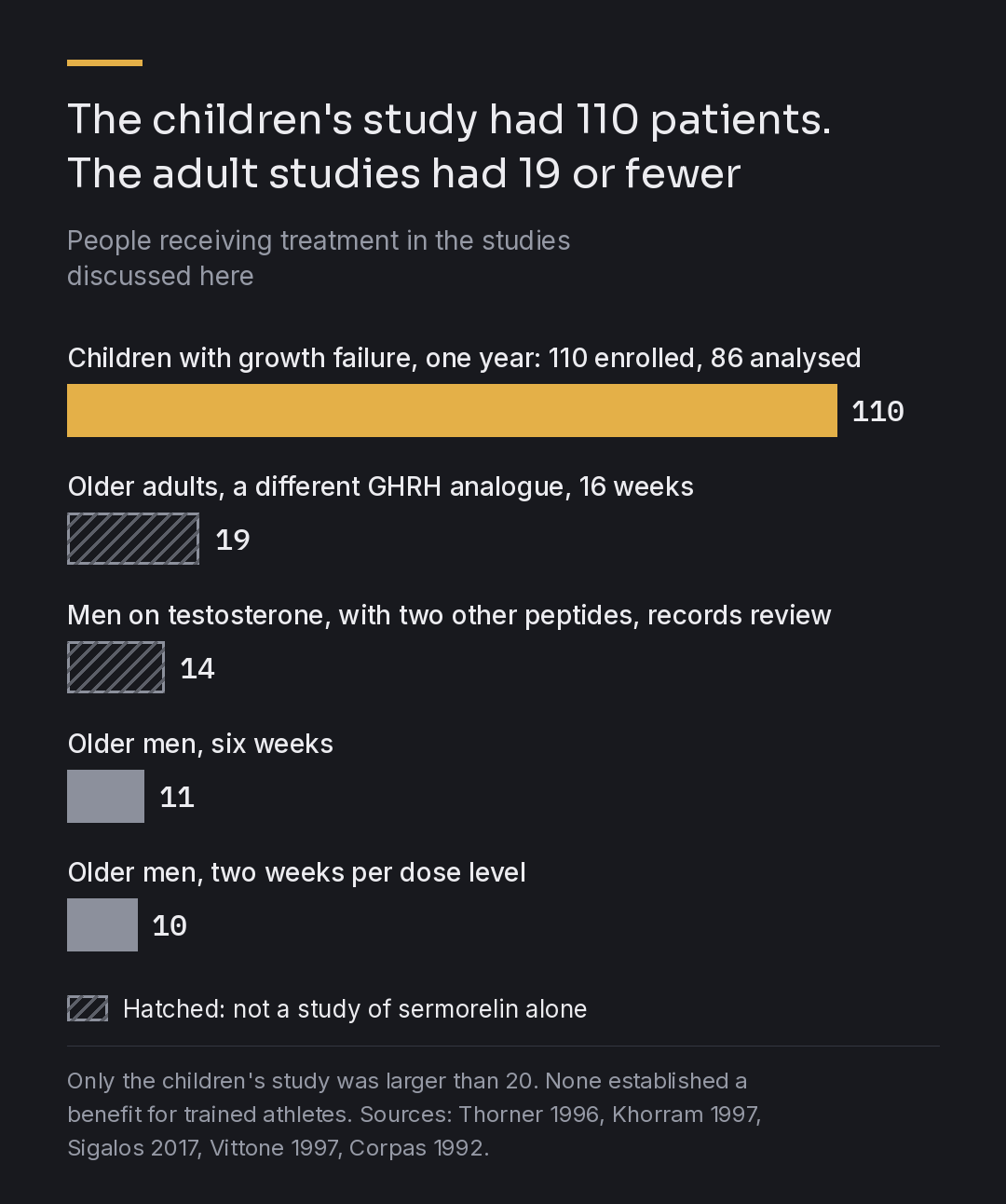
The largest treatment study we found was in children. In a one-year multicentre study published in 1996 under the name of the Geref International Study Group, 110 previously untreated children with growth hormone deficiency, all before puberty, received sermorelin. There was no comparison group. Among the 86 children who could be analysed, average growth rose from 4.1 centimetres a year at the start to 8.0 after six months and 7.2 after twelve. The authors reported no excessive rise in IGF-1, the blood marker that growth hormone drives, and no change in fasting glucose. A 1999 review of its use in children found it well tolerated, with brief facial flushing and pain at the injection site the most commonly reported side effects.
What was tested in adults
The adult studies we found are few, small and short. None of them establishes a performance benefit in people who train.
In 1992, researchers at the US National Institute on Aging gave ten healthy men with an average age of 68 two weeks of sermorelin injections at each of two dose levels, in random order, with two weeks off in between, and compared them with nine untreated young men. Only the higher dose significantly raised growth hormone and IGF-1; after it, the older men's values no longer differed significantly from the young men's. Fasting glucose and blood pressure did not change. The study did not measure muscle or strength.
In 1997, a team at Johns Hopkins gave eleven healthy men aged 64 to 76, all with low IGF-1 at the start, six weeks of sermorelin they injected themselves at home. The abstract describes no placebo group. Growth hormone released at night rose, but IGF-1 did not change. Two of six strength measures improved, the upright row and the shoulder press, as did one endurance test, the abdominal crunch. Weight, muscle and fat measured by body scan, and muscle tissue under the microscope did not change. No significant adverse effects were reported.
The same year, a team in San Diego tested a different GHRH analogue, not sermorelin itself, with one building block replaced at position 27. The abstract describes a single-blind study in ten women and nine men aged 55 to 71, who took saline for four weeks and then the analogue for 16 weeks. IGF-1 rose within two weeks and stayed higher for twelve, then drifted back towards its starting level by week 16. Lean body mass increased in the men only, skin thickness in both sexes, and insulin sensitivity in the men. The only adverse effect reported was a temporary rise in blood fats. The comparison was with each person's own saline month, not with a separate group.
The men on testosterone
The study closest to many of our readers is not a trial. In 2017, urologists at Baylor College of Medicine reviewed the records of 105 men on testosterone therapy who wanted more lean mass and less fat and had been prescribed sermorelin together with two other peptides, GHRP-2 and GHRP-6. Only 14 met the strict inclusion criteria. Their average age was 33, and after an average of 134 days their mean IGF-1 had gone from 159.5 to 239.0 nanograms per millilitre. Men who were also taking a drug that blocks estrogen production or action had smaller increases. The abstract reports no measure of muscle, fat or strength, and because three substances were taken together, the result cannot be attributed to sermorelin.
Where the rules stand
Geref is no longer approved, but the FDA's 2013 finding means its departure is not on record as a safety decision. A 2026 review by endocrinologists in Poznań concluded that in healthy people "clinically meaningful benefits" of sermorelin "remain uncertain because the human evidence base is limited and largely indirect", and that no long-term safety data are available for this off-label use. The World Anti-Doping Agency's 2026 Prohibited List names sermorelin among growth hormone releasing factors in class S2.2.4, prohibited at all times, in and out of competition.
What it means for a blood test
The outcome these studies measured most often was a blood marker, IGF-1, and even that did not always move: it rose at the higher dose level in the 1992 study, did not change in the six-week study, and drifted back towards its start before the end of the 16-week study of the variant. Lean body mass measured by scan rose in one study, and that study was of a different analogue, in men only; a rise in that measure does not by itself show muscle gain. In the studies we found, no one tested whether sermorelin helps people who train.
Sources
- US Food and Drug Administration, Federal Register, 4 March 2013: Geref (sermorelin acetate) was not withdrawn from sale for reasons of safety or effectiveness federalregister.gov
- Thorner and colleagues for the Geref International Study Group, Journal of Clinical Endocrinology and Metabolism, 1996: sermorelin in children with growth hormone deficiency doi.org
- Prakash and Goa, BioDrugs, 1999: sermorelin in the diagnosis and treatment of children with growth hormone deficiency doi.org
- Corpas and colleagues, Journal of Clinical Endocrinology and Metabolism, 1992: growth hormone releasing hormone (1-29) in old men doi.org
- Vittone and colleagues, Metabolism, 1997: growth hormone releasing hormone (1-29) in healthy elderly men doi.org
- Khorram and colleagues, Journal of Clinical Endocrinology and Metabolism, 1997: a growth hormone releasing hormone analogue in age-advanced men and women doi.org
- Sigalos and colleagues, American Journal of Men's Health, 2017: growth hormone secretagogues in men on testosterone therapy doi.org
- Dominikowski and colleagues, Frontiers in Endocrinology, 2026: performance-enhancing peptides acting on the growth hormone axis doi.org
- US Food and Drug Administration, briefing document on CJC-1295 for the Pharmacy Compounding Advisory Committee, 4 December 2024 fda.gov
- World Anti-Doping Agency, 2026 Prohibited List wada-ama.org
For educational purposes only. Not medical advice.
Every blood draw, followed against its reference band.
First month free for new subscribers.