
How much protein can one meal use? In a 12-hour study, 100 grams beat 25, and nothing above 100 was tested
In December 2023 a group at Maastricht University published a study with a bold title: the body's response to eating protein after exercise "has no upper limit". They gave young men either 25 or 100 grams of milk protein in a single drink after a workout and followed what happened for 12 hours. On the study's main measure, 100 grams did more than 25, and the gap was still widening when the measurements stopped.
That result is real. The title claims more than the experiment tested. We read the paper in full, compared it with the earlier experiments it challenges, and read the abstract of a published commentary on it.
What "use" means here
The question "how much protein can one meal use" mixes three different things. Absorption is protein from the gut reaching the blood as amino acids. Muscle protein synthesis is the rate at which muscle builds new protein, which is what these laboratory studies measure. Muscle growth is what is left after synthesis minus breakdown, added up over weeks. None of the studies below measured growth. They measured synthesis, over hours.
What the Maastricht team did
The 36 men were healthy, aged 18 to 40 and recreationally active: to take part they had to do sports or exercise one to three times a week. Twelve were randomly assigned to each of three drinks. After an overnight fast, each did a 60 minute workout on four machines covering legs, back and chest, then drank water containing no protein, 25 grams or 100 grams of milk protein. Neither the men nor the researchers knew which.
The milk protein contained amino acids carrying a chemical label, and the men also received labelled amino acids through a vein. Together, those tracers let the researchers estimate how amino acids from the drink moved through the body. Blood was sampled repeatedly for 12 hours and muscle samples were taken from the thigh right after the workout and at 4, 8 and 12 hours. The trial was registered in advance, and its main outcome was the synthesis rate of myofibrillar protein, the contractile part of muscle, over the full 12 hours.
What they found
On that main outcome, the three groups differed from one another: 100 grams above 25, and 25 above none. Compared with 25 grams, synthesis after 100 grams was about 20% higher in the first four hours and about 40% higher from hour four to hour twelve.
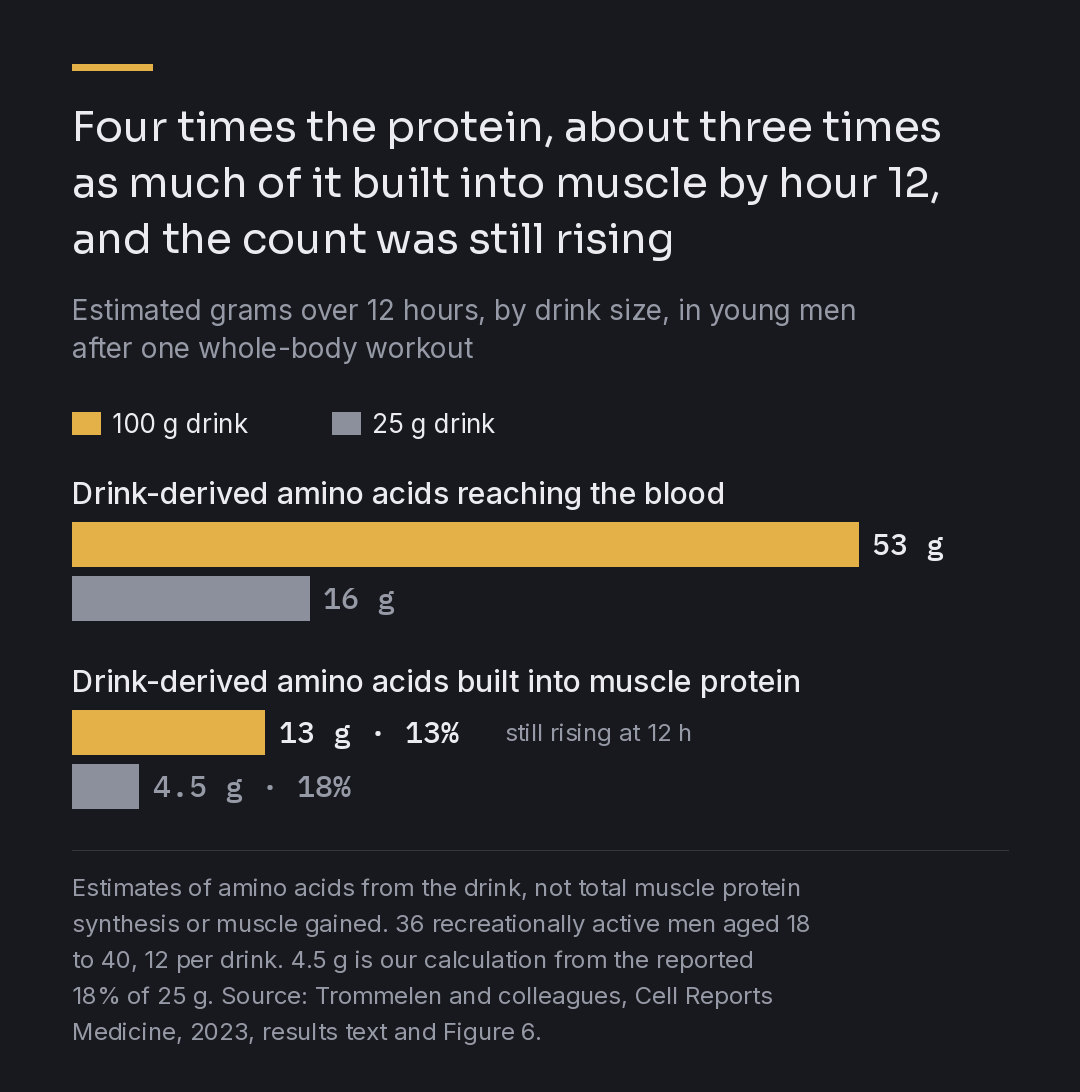
The big drink was also slow to arrive. By 12 hours, an estimated 66% of the protein in the 25 gram drink had appeared in the blood as amino acids. For the 100 gram drink the figure was 53%, and it had not levelled off when sampling stopped. In absolute terms, that is 53 grams against 16 grams.
The researchers also estimated how much of the drink itself ended up built into muscle protein. After 25 grams it was 18% by 12 hours, about 4.5 grams by our arithmetic, and most of that went in during the first four hours. After 100 grams it was 13 grams, or 13%, and the amount rose almost in a straight line from the first biopsy to the last. As a share of the drink, the smaller dose did better within the 12 hours; in grams, the larger one did, and it was not finished. These figures track amino acids from the drink built into muscle. They are not measurements of total muscle protein synthesis or of muscle gained.
Amino acid burning, called oxidation, increased with more protein, but the authors considered that increase small relative to the increase in protein synthesis across the whole body. When they recalculated figures from two earlier studies, they put oxidation at less than 15% of the extra protein eaten.
At the times sampled, the selected signalling and gene markers in muscle showed no detectable effect of the protein, even while synthesis stayed raised. That disconnect had appeared in earlier studies; Maastricht followed it across a longer response. The authors conclude that those markers "should not be used as a proxy" for how much muscle protein is being made.
The earlier experiments
The idea of a per-meal ceiling grew from experiments like these. In a 2009 study, six healthy young men did a hard leg workout on five occasions and drank 0, 5, 10, 20 or 40 grams of egg protein. Over four hours, muscle protein synthesis "was maximally stimulated at 20 g", and burning of the amino acid leucine rose after 20 and 40 grams.
In a 2014 study, 48 resistance-trained young men ate a standardised high-protein breakfast, did a one-leg workout three hours later, then drank 0, 10, 20 or 40 grams of whey. Over four hours, 20 and 40 grams raised synthesis by 49% and 56% above no protein, and the authors wrote that 20 grams "is sufficient for the maximal stimulation" in men of about 80 kilograms.
Not every experiment agreed. In 2016, 30 resistance-trained men did a workout for the whole body, and 40 grams of whey raised synthesis more than 20 grams did. Those authors pointed to the amount of muscle worked as the likely difference, and wrote that differences in measurement time between studies were "unlikely to explain" their result.
So the earlier studies differ from Maastricht in several ways at once: the protein, the workout, the men and the length of measurement. The Maastricht paper argues that earlier work tested limited amounts, at most 45 grams, over short periods, at most six hours. Its own data cannot say which of those differences produced the different answers, and a gap had already opened in its first four hours.
Spreading protein out
The Maastricht trial gave each man one drink. It never compared eating protein at once with eating the same amount spread across the day. An earlier experiment did. In 2013, 24 healthy trained men were split into three groups of eight. After a workout, each group drank the same 80 grams of whey over 12 hours, as eight servings of 10 grams, four of 20 or two of 40. All three raised synthesis above rest, and the four-serving group's synthesis was 31 to 48% higher than the other two. That was also a single-day experiment with whey and a different workout, not evidence about muscle growth over months.
The Maastricht authors argue that their results support "more flexibility in feeding patterns". That is their interpretation of a comparison between one 25 gram and one 100 gram drink, not a test of meal timing.
What the title leaves out
The title says "no upper limit". The discussion section says "no apparent upper limit". The experiment tested two protein doses alongside a zero-protein drink, and nothing between or above the two doses. The authors chose 100 grams as "the largest amount of protein that we consider feasible to consume in a single meal". These comparisons can show that the larger dose did more. They cannot locate a ceiling or rule one out.
It measured 12 hours after one workout and one drink, and did not measure muscle size or strength. The authors write that "the present work was acute in nature", and raise the possibility that large gains after a meal could be offset by more amino acid burning in a later fast. Some limits cut the other way: several responses to 100 grams had not returned to baseline at 12 hours, so the authors call their figures minimum estimates, and they note that a technical feature of the tracers would, if anything, make the gap between the drinks larger than observed. Later compensation and the tracer effect are possibilities the authors discuss; the persistence of several responses at 12 hours was observed.
The authors also say they do not know whether the findings apply to other people or conditions. The protein was a single liquid drink on an empty stomach after a full-body session.
A published commentary
In 2024 Oliver Witard, first author of the 2014 study, and Mettler published a commentary. We read its abstract only. It calls the findings "important scientific advances", describes the men as "recreationally active (but not resistance-trained)", and cautions that "the practical implications of these findings may have been misinterpreted, at least in terms of dismissing the concept of protein meal distribution". It adds that, based on emerging evidence, the "no upper limit" idea "does not appear to translate to resistance-trained young women".
The abstract does not name that evidence. One study we found in trained women, published online a few months before the Maastricht paper, followed 24 women through two whole-body workouts four hours apart, each followed by 15, 30 or 60 grams of whey, with eight women per amount. Measured with heavy water for up to 24 hours, 30 and 60 grams raised synthesis above baseline and 15 did not, and the study detected no difference between the 30 gram and 60 gram conditions. The design differs from Maastricht's in protein, method and group size, and we do not know whether it is the study the commentary means.
Who was involved
One of the Maastricht authors is an employee of FrieslandCampina, a dairy company. The paper states that the company "had no role in funding, data collection and analysis, or preparation of the manuscript". The article text does not name the study's funder; it points readers to university pages listing the career funding of two of the authors.
What it does and does not tell you
After one hard full-body session, in recreationally active young men, a 100 gram drink of milk protein produced a greater and longer rise in muscle protein synthesis than a 25 gram drink, over 12 hours, and little of the extra protein was burned.
It does not tell anyone how much protein to eat or at which meal. It does not explain why earlier experiments found a different dose response. Whether one large serving builds more muscle over months than several smaller ones needs longer trials measuring changes in muscle. Explaining the different short-term dose responses needs direct comparisons that control the competing design differences.
Sources
- Trommelen and colleagues, Cell Reports Medicine, 2023: The anabolic response to protein ingestion during recovery from exercise has no upper limit in magnitude and duration in vivo in humans doi.org
- Moore and colleagues, American Journal of Clinical Nutrition, 2009: Ingested protein dose response of muscle and albumin protein synthesis after resistance exercise in young men doi.org
- Witard and colleagues, Am J Clin Nutr, 2014: Myofibrillar muscle protein synthesis rates subsequent to a meal in response to increasing doses of whey protein at rest and after resistance exercise doi.org
- Macnaughton and colleagues, Physiological Reports, 2016: The response of muscle protein synthesis following whole-body resistance exercise is greater following 40 g than 20 g of ingested whey protein doi.org
- Areta and colleagues, Journal of Physiology, 2013: Timing and distribution of protein ingestion during prolonged recovery from resistance exercise alters myofibrillar protein synthesis doi.org
- Mallinson and colleagues, Scand J Med Sci Sports, 2023: Protein dose requirements to maximize skeletal muscle protein synthesis after repeated bouts of resistance exercise in young trained women doi.org
- Witard and Mettler, IJSNEM, 2024: The Anabolic Response to Protein Ingestion During Recovery From Exercise Has No Upper Limit in Magnitude and Duration In Vivo in Humans: A Commentary doi.org
For educational purposes only. Not medical advice.
Every set as lifted, drop sets and myo-reps included.
First month free for new subscribers.