
Progressive overload: a fixed weight still built muscle, and a late signal favoured progression
Both legs grew. Over 24 sessions, a leg that lifted the same weight every time and a leg whose load kept rising both added measurable muscle, and at no single measurement was the difference between them statistically significant. An exploratory comparison, made after the main analysis, found a larger increase with load progression between sessions 18 and 24.
That is the shape of a trial released online as an accepted manuscript on 15 October in the International Journal of Sports Medicine, by a team at the Federal University of São Carlos, in Brazil. Progressive overload, the idea that the training stimulus has to keep rising for muscle to keep adapting, is a basic principle of strength programming, yet the authors cite only one earlier experiment that compared training with and without load progression. This one gave each volunteer both conditions at once.
One person, two legs
Of 36 young adults randomised, 31 completed the intervention and were analysed: 11 women and 20 men, physically active, who had not trained their legs with weights in the previous six months. Each person trained one leg on each protocol, on a leg extension machine, three sets per leg, twice a week for 12 weeks, 24 sessions in all. Which leg got which protocol was decided at random.
On one leg, participants were instructed to reach concentric failure in every set, with the load adjusted to keep failure within 10 to 12 repetitions. On the other, the load chosen at the start never changed, and each set stopped at 10 to 12 repetitions even when more were possible. An assessor who did not know which leg was which measured the cross-sectional area of the vastus lateralis, the large muscle on the outside of the thigh, by ultrasound at mid-thigh, at the start and after sessions 6, 12, 18 and 24.
What the scans showed
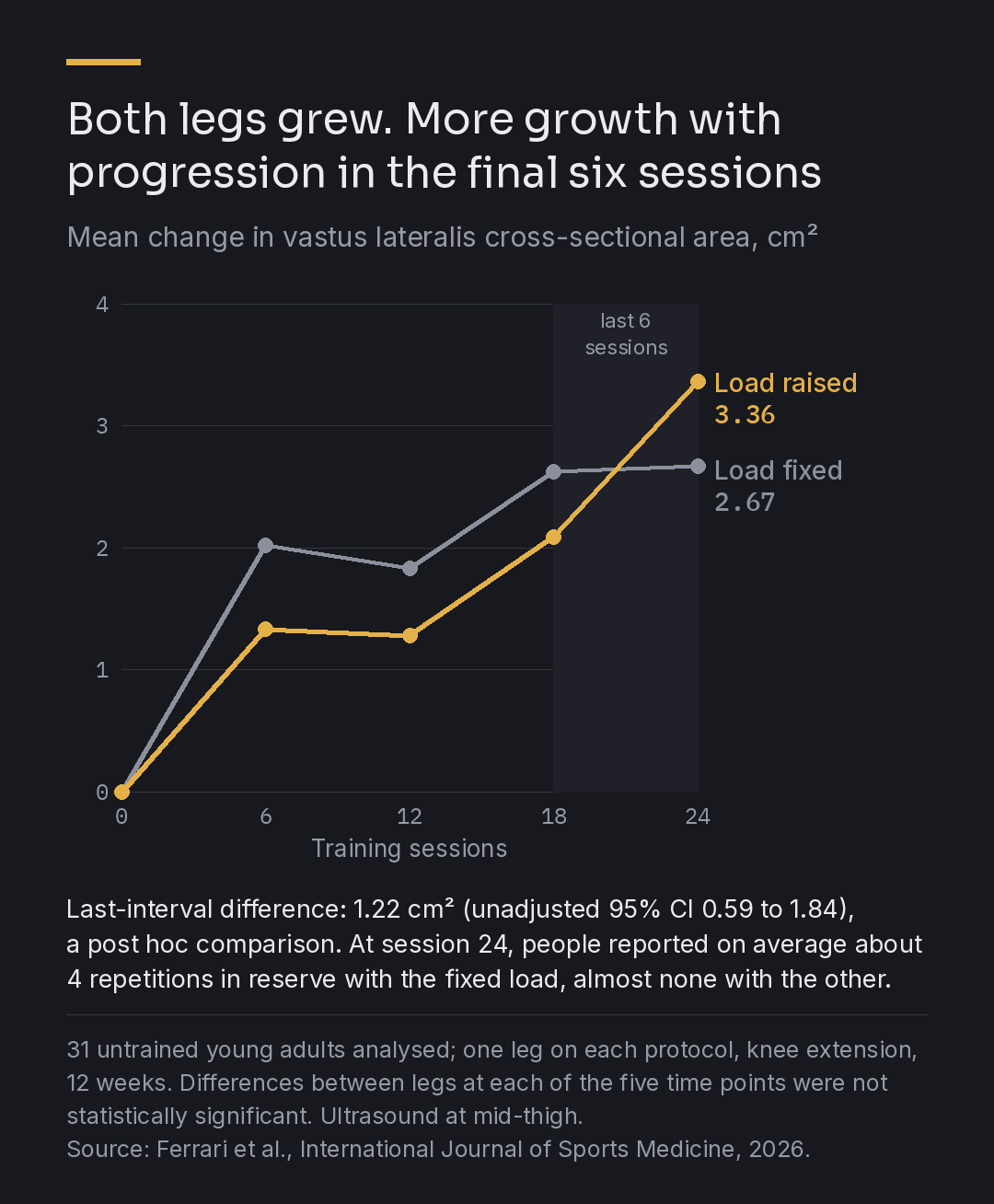
By session 24, the thigh muscle had gained on average 3.36 square centimetres on the leg with the rising load and 2.67 on the leg with the fixed load. At none of the five measurement points was the difference between legs statistically significant once the authors adjusted for multiple comparisons. The overall analysis did find that the two trajectories differed over time (interaction p = 0.002).
The fixed-load leg was numerically ahead at the first three follow-up assessments, by about half a square centimetre, although these differences were not statistically significant either. Between sessions 18 and 24, the leg with the rising load gained on average 1.26 square centimetres and the fixed-load leg 0.05. That difference, 1.22 square centimetres (unadjusted 95% confidence interval 0.59 to 1.84), is the exploratory estimate of the difference in gains during that interval.
The authors are explicit about its status: the direct comparison of that last interval "was not prospectively specified in the trial registration or a formal statistical analysis plan and was conducted as a post hoc follow-up" to the overall result. They also note that with five measurements spread over 12 weeks, the design cannot pinpoint the session at which the paths began to separate. It is a pattern to test, not a settled threshold. Their starting hypothesis, stated in the paper, was exactly this kind of late attenuation without progression.
The weight stayed the same; the effort did not
The more telling numbers may be the ones the volunteers reported. After every set, each person said how many more repetitions they could have done. On the leg with the rising load, the average stayed close to zero from the first session (0.47) to the last (0.20). On the fixed-load leg it climbed from 1.50 to 4.08. Average perceived effort on a 0 to 10 scale told the same story: it stayed near 9 on one leg and fell from 7.8 to 4.9 on the other.
The fixed load, in other words, did not stay the same stimulus. As the leg adapted, the same weight felt easier, and sets ended further from failure. Here both the load and the repetitions were capped in the fixed-load condition, and reported effort declined. That decline is a plausible explanation for the late pattern, but the trial cannot establish its independent contribution: because the fixed-load leg also stopped short of failure, the effect of not adding weight cannot be separated from the effect of training further from failure.
The authors also point out that progression does not have to mean adding weight. Adding repetitions at the same load is another way to raise the stimulus, and other trials they cite found similar muscle growth with either approach.
Who this applies to
The limits are the usual ones for a careful laboratory study, and the authors list them. The volunteers had not performed lower-limb resistance training for at least six months, and some of the early growth may reflect swelling rather than new muscle. The exercise was a single-joint machine movement, measured in a single muscle, over 12 weeks; the authors say the results should not be generalised to older adults, trained lifters or multi-joint exercises. Strength was not measured. And training one leg could also have increased strength in the other, making the fixed load less demanding; the study did not measure whether that happened.
The trial was funded by Brazil's national research council, CNPq, and the São Paulo research foundation, FAPESP, and registered in the Brazilian clinical trials registry on 13 May 2025, the same month enrolment began. The authors declared no conflicts of interest.
What it adds
The trial documents substantial growth under both protocols in young, untrained adults, and an exploratory late difference in their trajectories that lines up with a fall in reported effort on the fixed load. It does not establish a progression schedule for experienced lifters, or show that an effort rating can predict when growth will slow. The unanswered question is whether the late difference would persist if the two protocols kept sets comparably close to failure.
For educational purposes only. Not medical advice.
Every set as lifted, drop sets and myo-reps included.
First month free for new subscribers.