
MOTS-c rises when you train. The FDA identified no public clinical data on taking it
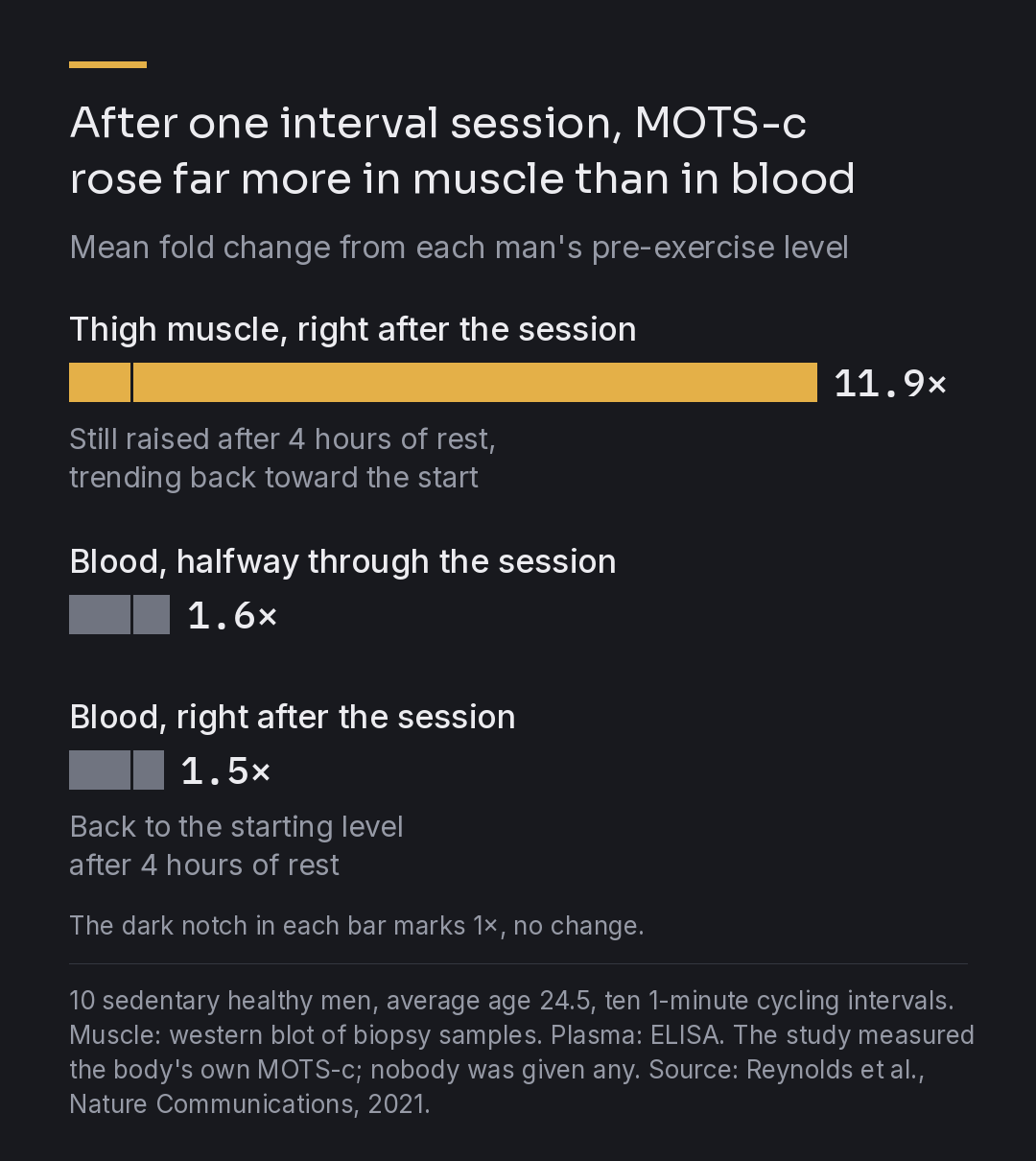
Ten young men who did little exercise came to a laboratory in Auckland, fasted overnight, and rode a stationary bike through ten one-minute intervals at their peak power, each followed by 75 seconds of rest or easy pedalling. Researchers took a sample of thigh muscle before and right after. In the muscle, a peptide called MOTS-c averaged 11.9 times each man's starting level. In the blood it rose about 1.5-fold and was back to where it started four hours later.
In that 2021 study in Nature Communications, the men were not given MOTS-c: researchers measured the peptide their own bodies made. Products containing the peptide are offered online for uses that include improving physical performance, according to the US Food and Drug Administration. In its review for a July 2026 advisory meeting, the agency said it did not identify publicly available clinical studies evaluating the administration of MOTS-c to humans.
What has been measured in people
Published human research has mainly measured the MOTS-c the body makes, through small exercise experiments and observational studies, including one large genetic analysis. In the Auckland experiment, muscle levels were still raised at the last biopsy, four hours after the session, though trending back toward baseline; blood levels had already returned to baseline.
A 2020 study of healthy men from the same New Zealand group found that MOTS-c in the blood was lower with age, while muscle levels were about 1.5 times higher in men aged 45 to 55 and 70 to 81 than in men aged 18 to 30. The authors linked the muscle finding to the shift toward slow-twitch fibres that comes with ageing.
A cross-sectional study published in October compared 30 men aged 18 to 25: 10 elite track and field athletes, 10 recreationally active and 10 sedentary. Serum MOTS-c was highest in the athletes and lowest in the sedentary group, and correlated with absolute VO2max (r = 0.892) across the three groups. Grip strength was not significantly correlated. The authors note that the design "precludes causal inference": fitter men may have more MOTS-c without the peptide being what made them fit.
The metabolic picture is less tidy. A 2018 study of 20 people found similar blood levels in lean and obese volunteers, and among the lean ones, higher MOTS-c went with more insulin resistance, not less. More circulating MOTS-c, in other words, cannot simply be read as a better metabolic state. In three cohorts totalling 27,527 people, a 2021 analysis found that men carrying an Asian-specific variant of MOTS-c had a higher prevalence of type 2 diabetes; women with the variant did not. In one of the cohorts, the higher prevalence appeared only in the least physically active men.
What it did in mice
The treatment results discussed here come from rodents. In 2015, a team at the University of Southern California reported that mice treated with it did not develop the insulin resistance that normally comes with age or with a high-fat diet, and did not become obese on that diet. In the 2021 paper, treated mice of three ages ran longer on a treadmill than untreated ones; old mice ran about twice as long. Mice that started intermittent treatment late in life did better on grip strength, stride length and a walking test. Their overall lifespan, however, did not differ significantly from that of untreated mice.
The FDA listed the limits of this body of work: studies confined to cells and small rodent models, and no known molecular target from which to predict which organs might be affected.
A peptide written in mitochondrial DNA
Almost every protein in the body is coded in the DNA of the cell nucleus. Mitochondria, the structures that turn food into usable energy, carry a small genome of their own. The 2015 paper reported that a short stretch inside one mitochondrial gene, the one for 12S ribosomal RNA, codes for a 16-amino-acid peptide, named MOTS-c for mitochondrial open reading frame of the 12S rRNA type-c.
In cells, it slowed the folate cycle and the purine synthesis tied to it, which led to activation of AMPK, an enzyme that senses how much energy a cell has available. A 2018 follow-up from the same group found that under metabolic stress MOTS-c moves into the nucleus and changes the activity of nuclear genes, including ones involved in the antioxidant response. In the FDA's reading, the way MOTS-c turns on AMPK is still "poorly understood."
The trials that exist
A ClinicalTrials.gov search for "MOTS-c OR CB4211" on 6 November 2026 identified two trials testing administration of MOTS-c or an analogue. CohBar, a US company, ran a phase 1a/1b study of CB4211, which it described as an improved analogue of MOTS-c, not MOTS-c itself. The registry lists 88 participants and completion in April 2021, with no results posted. In an August 2021 press release, the company reported lower liver-damage markers and glucose after four weeks in the phase 1b part, which enrolled 20 people with obesity and fatty liver disease, and said liver fat fell substantially in both the treated and the placebo groups. The same release reported injection-site reactions and no serious adverse events. A Europe PMC search for "CB4211" on the same date found no peer-reviewed report of that trial. Two co-authors of the 2021 Nature Communications paper, Pinchas Cohen and Changhan Lee, disclosed in it that they were consultants to and shareholders of CohBar.
The second is a phase 2a study sponsored by Hudson Biotech, with a hospital site in Shenzhen, China, a February 2026 start and recruiting status. It plans to randomise 120 adults with prediabetes and overweight or obesity to MOTS-c or placebo. Its primary outcomes are insulin sensitivity at 12 weeks and the incidence of treatment-emergent adverse events through 16 weeks. The registry estimates primary completion in February 2027; it gives no publication date.
Where the rules stand
MOTS-c is not a component of any FDA-approved drug. Wells Pharmacy Network, a US compounding group, nominated it for the list of substances that pharmacies may compound under section 503A, for uses including insulin resistance, obesity, osteoporosis and longevity, then withdrew the nomination. The FDA evaluated it anyway and recommended against listing both the free base and the acetate salt. Its reasons: the substance is not well characterised, with no data on impurities, aggregates or bacterial endotoxins in the certificates it reviewed; it identified no clinical evidence for the nominated uses and no human safety data; and an injected peptide raises a concern about immune reactions, with no clinical studies of that risk identified. In human blood in the laboratory, the agency noted, MOTS-c is quickly broken down into shorter peptides, and it is unclear whether an injection under the skin produces active levels over time. On the FDA's category 2 page, current as of 22 April 2026, MOTS-c appears among substances whose nominations were withdrawn, with the note that the agency "has not identified any human exposure data" on drug products containing it.
The advisory committee disagreed with the agency. On 23 July 2026 it voted 7 to 5, with two abstentions, to recommend inclusion, according to a summary by the law firm McDermott Will & Schulte. The vote does not bind the FDA, which said it would not make a final determination until the committee's input and its own reviews were complete.
In sport the answer is settled. The World Anti-Doping Agency's 2026 Prohibited List names MOTS-c, by its full name, among the activators of AMPK under metabolic modulators, section S4.4, which is prohibited at all times.
What is known, and what is not
In its July 2026 review, the FDA did not find in any public study an answer to what happens when a person takes MOTS-c: whether it reaches active levels, whether it changes anything a person who trains would notice, and what it does to the immune system. The registered phase 2a trial is designed to assess insulin sensitivity and adverse events in adults with prediabetes and overweight or obesity. It also lists an anti-drug-antibody assessment, if applicable, and no exercise-performance endpoint.
The cycling experiment measured how the body responds to exercise. It did not show that raising MOTS-c, by any route, makes a person fitter.
Sources
- Lee et al., The mitochondrial-derived peptide MOTS-c promotes metabolic homeostasis and reduces obesity and insulin resistance, Cell Metabolism, 2015 doi.org
- Kim et al., MOTS-c translocates to the nucleus to regulate nuclear gene expression in response to metabolic stress, Cell Metabolism, 2018 doi.org
- Reynolds et al., MOTS-c is an exercise-induced mitochondrial-encoded regulator of age-dependent physical decline and muscle homeostasis, Nature Communications, 2021 doi.org
- D'Souza et al., Increased expression of MOTS-c in skeletal muscle of healthy aging men, Aging, 2020 doi.org
- Cataldo et al., Plasma MOTS-c levels are associated with insulin sensitivity in lean but not in obese individuals, Journal of Investigative Medicine, 2018 doi.org
- Zhang et al., Associations of serum MOTS-c with exercise capacity and antioxidant markers in young males, Antioxidants, 2026 doi.org
- Zempo et al., A pro-diabetogenic mtDNA polymorphism in the mitochondrial-derived peptide MOTS-c, Aging, 2021 doi.org
- FDA, presentation on MOTS-c-related bulk drug substances, Pharmacy Compounding Advisory Committee, July 2026 fda.gov
- FDA, bulk drug substances that may present significant safety risks (category 2), page current as of 22 April 2026 fda.gov
- McDermott Will & Schulte, 27 July 2026: PCAC vote results on seven peptides mcdermottlaw.com
- ClinicalTrials.gov, NCT07505745: phase 2a trial of MOTS-c in adults with prediabetes and overweight or obesity clinicaltrials.gov
- ClinicalTrials.gov, NCT03998514: phase 1a/1b study of CB4211 clinicaltrials.gov
- CohBar, press release on topline results of the phase 1a/1b study of CB4211, 11 August 2021 (copy on MarketScreener) in.marketscreener.com
- World Anti-Doping Agency, Prohibited List 2026, section S4.4 wada-ama.org
For educational purposes only. Not medical advice.
Every set as lifted, drop sets and myo-reps included.
First month free for new subscribers.