
Mazdutide adds a glucagon signal to GLP-1. Its maker reports heart rate up 2.6 beats a minute in the main trial
Mazdutide is a single molecule that acts on two receptors: the one for GLP-1, the target of semaglutide, and the one for glucagon. On 27 June 2025 its developer, Innovent Biologics, announced that China's National Medical Products Administration had approved it for chronic weight management, and described it as the world's first dual glucagon and GLP-1 receptor agonist approved for weight loss. In GLORY-1, the main trial behind that approval, the company reports that the mean change in heart rate from the start to week 48 was plus 2.6 beats per minute on both doses tested. It did not give the figure for the placebo group.
For someone who tracks a morning resting pulse, that raises a question: could treatment move the reading independently of training?
What the main trial showed
GLORY-1, published in the New England Journal of Medicine in 2025, randomly assigned 610 Chinese adults with obesity, or with overweight and a related condition, to one of two doses of mazdutide or placebo for 48 weeks. Counting everyone regardless of whether they stayed on treatment, body weight changed by minus 11.0% and minus 14.0% on the two doses at week 48, against plus 0.3% on placebo. The most frequent side effects were gastrointestinal and mostly mild to moderate, and treatment was stopped because of side effects by 1.5% and 0.5% of people on the two doses and 1.0% on placebo. The trial was funded by Innovent.
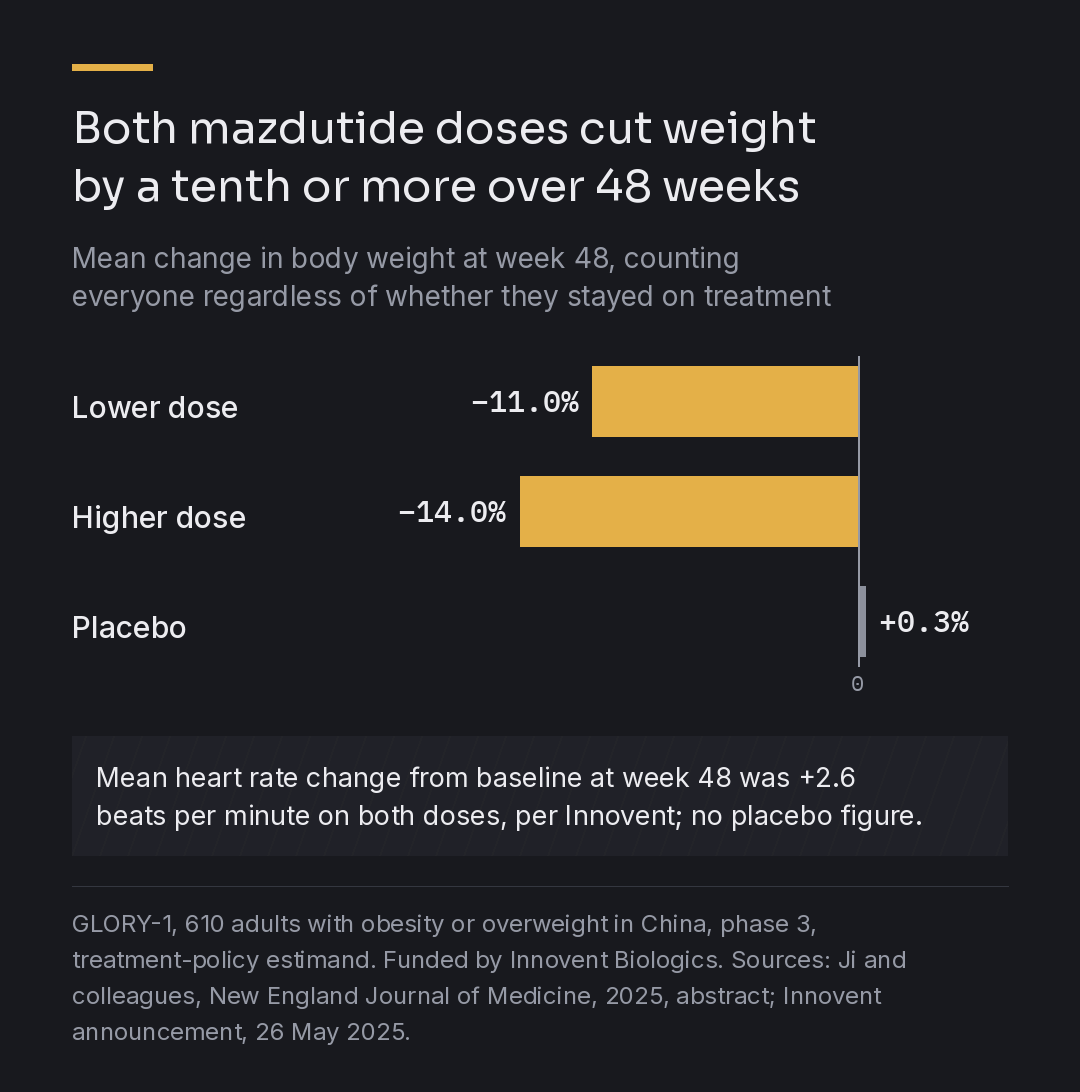
The heart rate figure does not appear in the journal abstract. It comes from the company's announcement of the publication, which says that at week 48 "the mean change from baseline in heart rate was 2.6 beats per minute" in both mazdutide groups. Without the placebo group's change, the figure cannot be read as a difference caused by the drug. The announcement adds that there were "no safety signals of increased cardiovascular risk". That statement does not establish cardiovascular safety, and it says nothing about what the change means for an individual.
What the early trial showed
The heart rate question was clearer in a smaller, earlier study. A phase 1b trial published in eClinicalMedicine in 2022 tested two higher-dose schedules in 24 Chinese adults, eight on mazdutide and four on placebo in each group, for 12 and 16 weeks. The largest reported mean increases in heart rate from the start were 17.4 and 11.6 beats per minute in the two mazdutide groups, against 4.3 on placebo. The authors wrote that "due to potential heart rate increase upon glucagon receptor agonism", drugs of this kind "may lead to more pronounced heart rate increase than GLP-1 agonists". Those are the largest group averages reported over the trial, in very small groups, and they are not comparable with a week-48 average in a larger one. The same paper notes that, in mice, mazdutide increased energy expenditure, one reason for adding the glucagon signal; none of these trials separates how much of any heart rate change comes from either receptor.
The later trials
Two larger trials reported in 2026. GLORY-2, in JAMA, gave a higher dose or placebo for 60 weeks to Chinese adults with obesity, some with type 2 diabetes; 461 received treatment and were analysed. Weight changed by minus 16.65% against minus 1.50%. Vomiting affected 53.1% of people on mazdutide and 1.3% on placebo, and nausea 46.9% against 3.2%; 2.9% stopped treatment because of side effects, against none on placebo. In the United States, a phase 2 trial funded by Eli Lilly gave one of three dose levels or placebo for 48 weeks to 179 adults with obesity or overweight and without type 2 diabetes. At 32 weeks weight had changed by between minus 7.3% and minus 18.1% across the mazdutide groups, against minus 0.9% on placebo, and 20% of people on the highest dose stopped treatment because of side effects. Those week-32 figures assume everyone kept taking the drug, unlike the GLORY-1 figures above, so the percentages should not be ranked against each other. The abstracts we could read for these two trials do not report heart rate.
The sources available to us do not report muscle outcomes, or results in people selected for athletic training. We could not read the full reports of GLORY-1, GLORY-2 or the US trial.
Where the rules stand
Our searches of the US Food and Drug Administration's approvals database on 10 November 2026, by generic name and by active ingredient, found no record for mazdutide. In China it is approved for chronic weight management, according to Innovent's announcement of 27 June 2025.
The World Anti-Doping Agency's 2026 Prohibited List does not name mazdutide. Its first class, S0, prohibits at all times any pharmacological substance not addressed elsewhere on the list that has no current approval from any government health authority for human therapeutic use. Mazdutide has an approval in China. How the agency classifies it is not stated in the list.
What it means for a resting pulse
If you track your heart rate over months, a rise of a few beats is something you would normally try to explain. The trials reported here describe averages in people with obesity, and the main trial's figure comes from a company statement without a placebo comparison. These averages make a drug-related change in heart rate plausible on mazdutide. They do not predict an individual athlete's morning resting pulse, or establish how much of any change the treatment causes.
Sources
- Ji and colleagues, New England Journal of Medicine, 2025: mazdutide in Chinese adults with obesity or overweight (GLORY-1) doi.org
- Innovent Biologics announcement, 26 May 2025: GLORY-1 published in the New England Journal of Medicine biospace.com
- Innovent Biologics announcement, 27 June 2025: mazdutide approved by China's NMPA for chronic weight management biospace.com
- Ji and colleagues, eClinicalMedicine, 2022: multiple-ascending-dose phase 1b trial of mazdutide doi.org
- Gao and colleagues, JAMA, 2026: mazdutide for weight reduction in Chinese adults with obesity (GLORY-2) doi.org
- Hsia and colleagues, Lancet Diabetes and Endocrinology, 2026: US phase 2 trial of mazdutide, funded by Eli Lilly doi.org
- World Anti-Doping Agency, 2026 Prohibited List wada-ama.org
For educational purposes only. Not medical advice.
Sleep, heart rate, blood pressure and glucose, read in one place.
First month free for new subscribers.