
Ipamorelin raises growth hormone. Its patient trials tested bowel recovery, and we found none that measured muscle
Ipamorelin is sold to people who train as a way to raise their own growth hormone. In healthy men it does that: a 1999 study recorded a burst of growth hormone at every infusion level it tested. What we could not find was the next step. Our searches of Europe PMC turned up no human trial of ipamorelin that measured muscle, fat or strength. The two phase 2 trials registered in patients tested something else: whether the bowel recovers faster after surgery. The one that was published found no significant difference from placebo.
What it does in healthy men
The 1999 study, in Pharmaceutical Research, gave 15-minute infusions at five levels, with eight healthy men at each level. Every level released growth hormone, in what the authors describe as "a single episode of GH release", peaking at about 40 minutes and falling to negligible levels afterwards. Ipamorelin itself had a terminal half-life of about two hours. The abstract reports drug concentrations and growth hormone responses. It reports no muscle, fat or strength outcomes.
What ipamorelin is
Ipamorelin is a peptide of five amino acids, described in 1998 by researchers at Novo Nordisk in the European Journal of Endocrinology. A 2009 paper describes it as an agonist of the ghrelin receptor; ghrelin and drugs that mimic it, the paper notes, "stimulate appetite and enhance gastric motility". The same family includes older compounds called GHRP-2 and GHRP-6.
What the discovery paper presented as new was selectivity. In pigs, GHRP-2 and GHRP-6 also raised ACTH and cortisol, two stress hormones, while ACTH and cortisol after ipamorelin were not significantly different from those after GHRH, the body's own releasing hormone. The authors called it "the first GHRP-receptor agonist with a selectivity for GH release similar to that displayed by GHRH". Those measurements were made in animals.
The trials after bowel surgery
The trials in patients went after that gut effect. Helsinn Therapeutics sponsored two randomised, double-blind phase 2 trials in patients having part of the bowel removed. In a rat model of the slowdown that follows abdominal surgery, called postoperative ileus, published in 2009, repeated intravenous treatment increased stool output, food intake and weight gain over 48 hours.
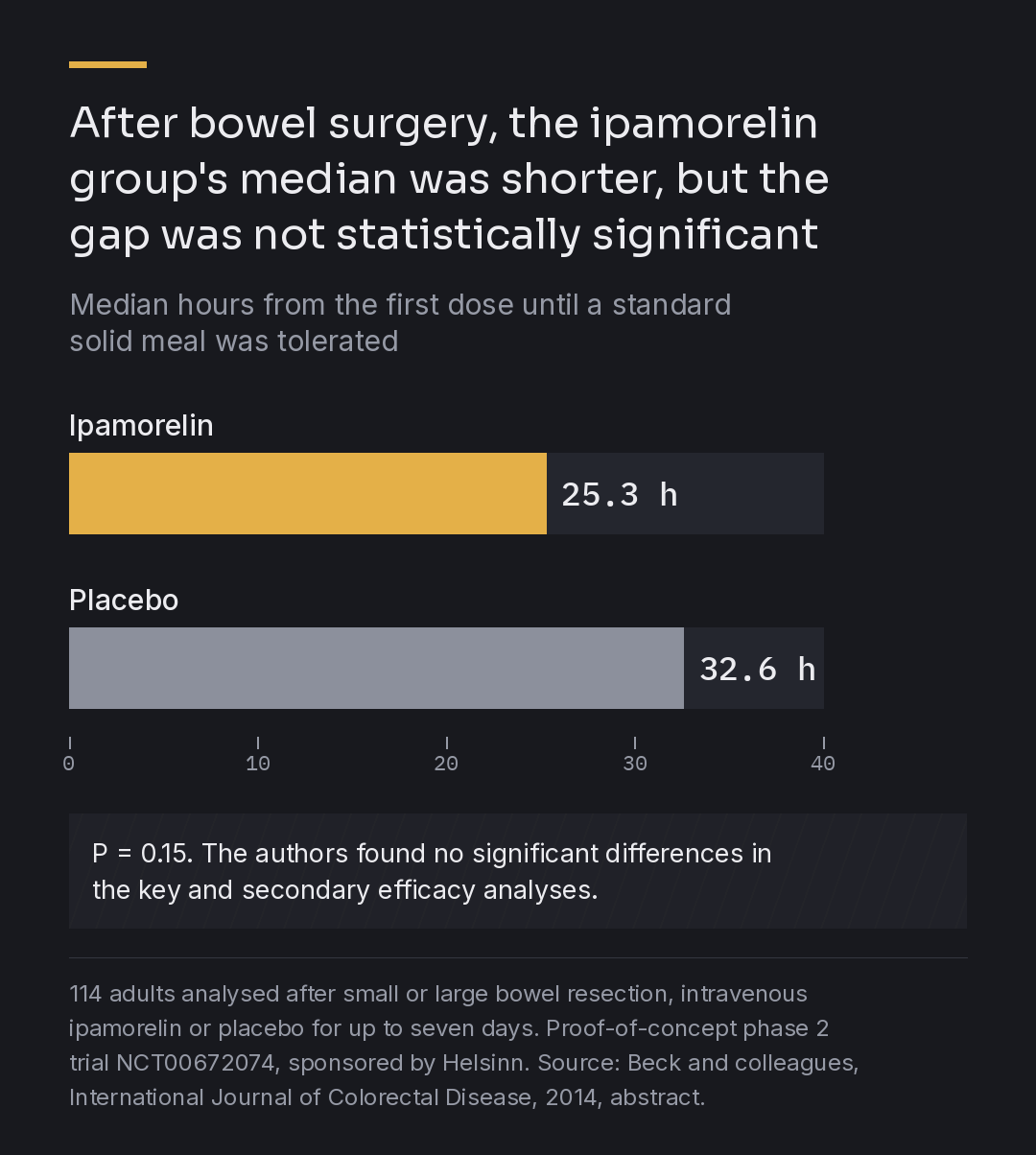
In the first trial, NCT00672074, 117 patients were enrolled to receive intravenous ipamorelin or placebo for up to seven days after open or laparoscopic surgery. Its results were published in 2014 in the International Journal of Colorectal Disease. The main measure was the time from the first treatment until patients tolerated a standard solid meal: a median of 25.3 hours on ipamorelin and 32.6 hours on placebo. The difference was not statistically significant, and the authors concluded there were "no significant differences between ipamorelin and placebo in the key and secondary efficacy analyses". They described the drug as well tolerated in that setting, and noted that the study was small and enrolled patients with a broad range of underlying conditions.
The second trial, NCT01280344, was larger: 320 patients in a dose-finding design with three ipamorelin groups and placebo, completed in 2014. Neither registry record contains posted results. The smaller trial has the journal report above; for the larger one, our search of Europe PMC found no peer-reviewed report.
These results neither show nor rule out an effect in people who train. The published patient trial assessed bowel recovery after up to seven days of treatment, and it does not establish long-term safety in healthy people who train.
What the FDA says
Our search of the FDA's drug approvals database on 10 November 2026 found no approval record for ipamorelin. On its page on bulk substances for compounding that may present significant safety risks, marked as current on 22 April 2026, the US Food and Drug Administration lists ipamorelin acetate in category 2 under its interim policy for outsourcing facilities, with an addition date of 29 September 2023. It also appears in the section for substances whose nominations for compounding were withdrawn. The FDA's stated reasons are a possible immune reaction caused by aggregation or impurities, the complexity of a peptide that "contains unnatural amino acids", and that "a study published in literature identified serious adverse events including death when ipamorelin was administered intravenously for improving gastric motility". The page does not identify that study or say that ipamorelin caused the death. For certain other injectable routes, the agency writes that it "lacks sufficient information to know whether the drug would cause harm".
What is sold outside medicine is a separate question from what was tested. A 2026 preprint, not yet peer reviewed, analysed a publicly available independent testing dataset of 6,441 peptide samples across fourteen compounds sold directly to consumers, ipamorelin among them. Depending on the standard applied, 41.6% to 71.1% of samples failed basic quality criteria, and 15% had measurable endotoxin. Its summary does not break those figures down by peptide.
Where it stands in sport
The World Anti-Doping Agency's 2026 Prohibited List names ipamorelin among growth hormone secretagogues in class S2, which is prohibited at all times, in and out of competition.
What is still missing
The human studies identified here are a growth hormone study in healthy men, a published trial of 117 patients after bowel surgery that found no significant benefit, and a larger trial with no published results that we could find. Their published abstracts and registered outcomes report no muscle, body composition or strength results, and the selectivity that made the drug interesting was shown in pigs. Whether a growth hormone pulse from ipamorelin changes anything a lifter cares about is a question no trial we found has asked.
Sources
- Gobburu and colleagues, Pharmaceutical Research, 1999: pharmacokinetic-pharmacodynamic modeling of ipamorelin in human volunteers doi.org
- Raun and colleagues, European Journal of Endocrinology, 1998: ipamorelin, the first selective growth hormone secretagogue doi.org
- Venkova and colleagues, Journal of Pharmacology and Experimental Therapeutics, 2009: ipamorelin in a rat model of postoperative ileus doi.org
- Beck and colleagues, International Journal of Colorectal Disease, 2014: randomized proof-of-concept trial of ipamorelin for postoperative ileus doi.org
- ClinicalTrials.gov record NCT00672074, phase 2 trial of ipamorelin for postoperative ileus (Helsinn) clinicaltrials.gov
- ClinicalTrials.gov record NCT01280344, phase 2 dose-finding trial of ipamorelin after bowel resection (Helsinn) clinicaltrials.gov
- US FDA, bulk drug substances for compounding that may present significant safety risks, content current as of 22 April 2026 fda.gov
- World Anti-Doping Agency, 2026 Prohibited List wada-ama.org
- Mendias and Awan, preprint, 2026: purity of research-grade peptides marketed directly to consumers (not peer reviewed) doi.org
For educational purposes only. Not medical advice.
Every blood draw, followed against its reference band.
First month free for new subscribers.