
hCG alongside testosterone therapy: the trial that measured the testis never counted sperm
Testosterone therapy replaces the hormone, and the body answers by switching off the signals that make its own. A 2025 review in Nature Reviews Urology states the consequence plainly: treatment with androgens from outside the body suppresses those pituitary signals, "drastically reduces intratesticular testosterone" and so impairs sperm production. Sperm production, the same review says, "often slowly resumes" after the therapy stops, at a rate that "shows highly variable kinetics". It also records that androgens from outside the body are contraindicated in men who are trying to conceive.
Human chorionic gonadotropin, hCG, is one approach studied for that problem. It is a hormone of pregnancy that acts on the same receptor as luteinizing hormone, the pituitary signal the therapy switches off, so in principle the testis keeps working while the therapy continues. The same review says gonadotropins "may be used to preserve or restore spermatogenesis in select populations receiving TRT". What follows is what the studies we found actually measured, and what they did not.
What the US label covers
The prescribing information we read for chorionic gonadotropin (Fresenius Kabi, version effective 11 April 2025) describes a hormone "obtained from the human pregnancy urine" and lists three uses: undescended testes in boys before puberty, "selected cases of hypogonadotropic hypogonadism (hypogonadism secondary to a pituitary deficiency) in males", and inducing ovulation in some infertile women. Protecting fertility during testosterone therapy is not among them.
The indications section opens, in capital letters, with a sentence about something else entirely: hCG "has not been demonstrated to be effective adjunctive therapy in the treatment of obesity", and there is "no substantial evidence" that it increases weight loss beyond calorie restriction.
Two warnings matter to a reader holding an injectable product made from urine. The label states that "anaphylaxis and other hypersensitivity reactions have been reported with urinary-derived HCG products". It also cautions that because androgens may cause fluid retention, hCG "should be used with caution" in people with cardiac or renal disease, epilepsy, migraine or asthma. One line is aimed squarely at anyone who tracks hormone panels: chorionic gonadotropin "may interfere with radioimmunoassay for gonadotropins, particularly luteinizing hormone".
The adverse reactions the label lists are headache, irritability, restlessness, depression, fatigue, edema, precocious puberty, gynecomastia and pain at the injection site. That section gives no frequencies for them.
The trial that measured the testis
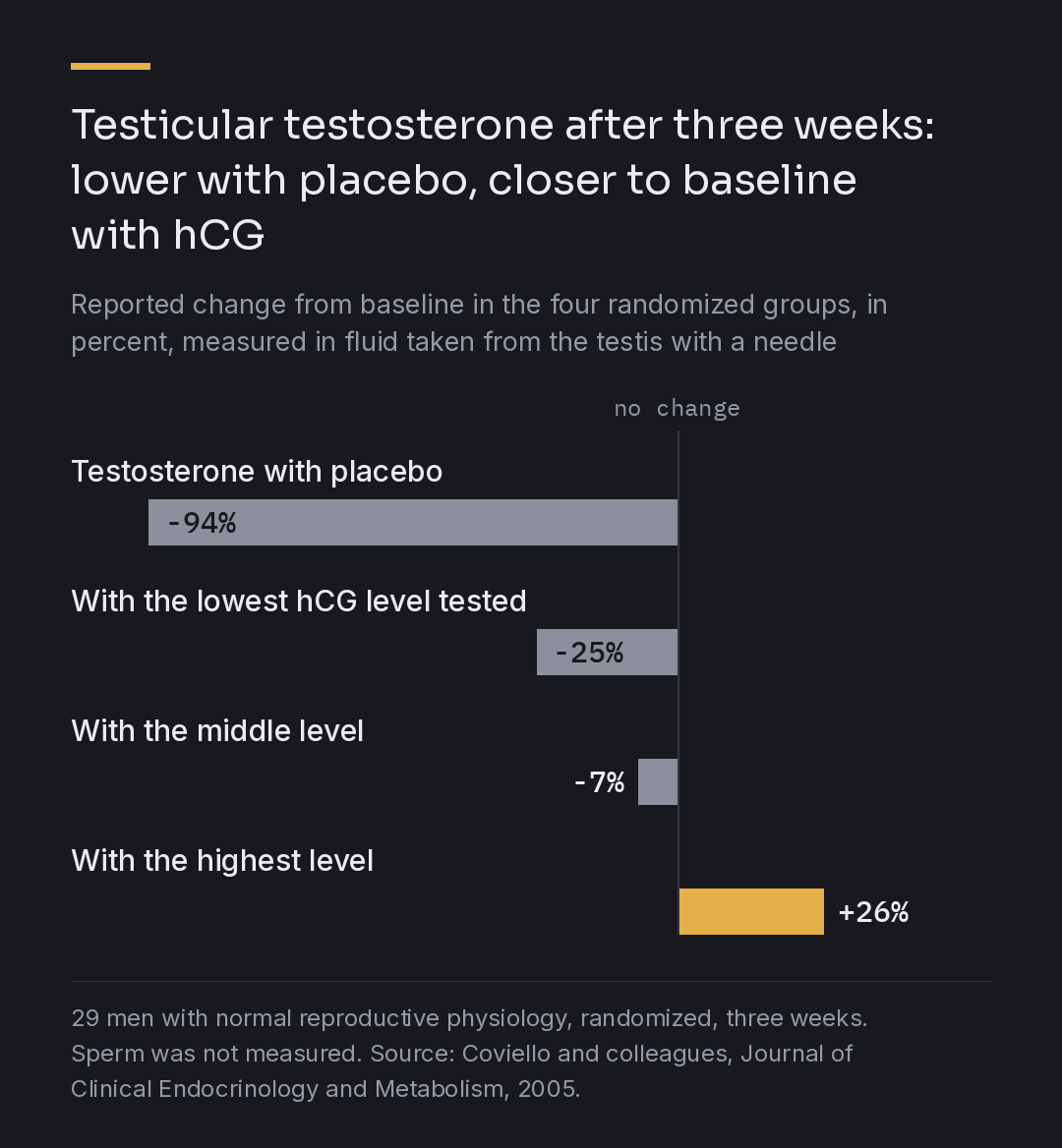
In 2005, Coviello and colleagues at the University of Washington gave 29 men with normal reproductive physiology testosterone injections for three weeks. Each man was randomized to receive, alongside them, either a saline placebo or hCG at one of three levels. Before and after, the researchers took fluid directly from the testis with a needle and measured the testosterone in it.
Inside the testis, testosterone runs far above the level in the blood. At baseline, serum testosterone was 1.2% of the testicular concentration. After three weeks on testosterone with placebo, the reported testicular level was 94% below baseline. In the hCG groups the reported changes tracked the level given: 25% below baseline at the lowest level tested, 7% below at the middle one, and 26% above baseline at the highest.
What the trial did not do is count sperm. A 2025 review that tabulates it records its semen outcome as "Not assessed". The men were young volunteers with normal hormones, not men being treated for low testosterone, and three weeks is a fraction of the cycle that produces sperm. The same review notes that in the two higher groups serum testosterone rose above the normal range. The authors of the trial wrote that extensions of their study "will allow determination of the ITT concentration threshold required to maintain spermatogenesis in man", and stated that the quantitative relationship between that concentration and sperm production "is not known".
A later University of Washington study proposed to address exactly that question. ITT-5 was registered in May 2014, set out "to determine how much male hormone, testosterone, is needed to maintain sperm production in the testis", and included an arm combining testosterone gel with hCG. Its record was last updated in December 2019 with the status withdrawn, nobody enrolled, and one line under why the study stopped: "No funding was obtained for this study." The sources we have do not establish a clinically usable testicular testosterone threshold for maintaining sperm production.
What was measured in men already on therapy
Three reports look at men who had taken androgens and wanted fertility. All three are retrospective: doctors read back through charts of men who had already been treated. None compared the hCG-based treatment with an otherwise comparable group that received no such treatment.
Hsieh and colleagues reviewed 26 hypogonadal men, mean age 35.9, given testosterone together with hCG, with a mean follow-up of 6.2 months. Mean serum testosterone went from 207.2 to 1,055.5 ng/dl. They reported no difference in semen parameters over more than a year of follow-up, that no patient became azoospermic, and that nine of the 26 contributed to a pregnancy with their partner.
Stocks and colleagues reviewed 77 men with previous testosterone use who sought fertility treatment between January 2020 and March 2024 and received hCG with follicle-stimulating hormone. Sperm concentration improved in 74% of them, and the share was the same, 74%, among the 50 who had stopped testosterone and the 27 who continued it. That comparison is the one control this set has: it does not test hCG against nothing, it tests continuing testosterone against stopping it. The two reports share their senior author, Larry Lipshultz.
The third looks at a different population again: men continuing non-prescribed androgens. Smit and colleagues reported on 19 men at a harm reduction clinic in the Netherlands, between April 2023 and July 2024, who had been using androgens for at least three months, were unwilling to stop, and were treated with hCG anyway. Mean total sperm count rose from 18.0 million to 146.9 million and mean total motile count from 1.1 million to 66.9 million, and the share of men with a normal total motile count went from 5% to 58%. The authors conclude that hCG "appears to be effective in improving spermatogenesis in the majority of men who continue non-prescribed androgen use, whereas some men remain oligospermic or azoospermic". They report funding from the Doping Authority Netherlands and a hospital academy.
The randomized trial in a different clinic
One randomized trial in this evidence does combine testosterone with hCG, and it was run in a different clinical population: men with congenital hypogonadotropic hypogonadism, whose own gonadotropin signal is deficient from birth rather than suppressed by treatment. Singhania and colleagues ran an open-label randomized pilot study between June 2020 and December 2021, comparing a low-dose hCG regimen given with follicle-stimulating hormone and testosterone against conventional higher-dose hCG with the same follicle-stimulating hormone. Of 30 patients, 23 (76.7%) achieved spermatogenesis, at a median of 12 months, with no significant difference between the two regimens. The two group percentages printed in the abstract do not reconcile with that overall figure, so we do not reproduce them.
That trial tests one way of giving gonadotropins against another in men who need them to have any signal at all. It is not a test of whether adding hCG protects fertility in a man whose own signal is being suppressed by therapy.
The review that collects these studies is a narrative one, and its authors say so: they acknowledge "the potential for selection bias". They also report that the American Urological Association's infertility guideline, while noting that some studies suggest spermatogenesis may be preserved this way, considers the current evidence insufficient to support the approach for men who want fertility later. We read that characterization in the review; the guideline itself sits behind a login.
Two rules that changed around it
On 23 March 2020, approved hCG applications in the United States moved from the drug-approval framework to biologics licences. The FDA notice to compounders spells out the consequence: transitioning products "will not be eligible for the exemptions for compounded drugs under sections 503A and 503B", and human chorionic gonadotropin is named among four such substances that outsourcing facilities had reported using.
For anyone who competes, the 2026 WADA Prohibited List places chorionic gonadotrophin in section S2.2.1, "testosterone-stimulating peptides in males", prohibited at all times. The restriction is written for males; the same section does not prohibit it in females.
What this means for a blood test
In the three-week trial, serum testosterone increased in every group, including the placebo group, whose testicular testosterone fell sharply. Serum testosterone alone therefore did not describe what happened inside the testis. The measurement that did describe it was made in fluid taken from the testis with a needle, not in blood drawn from a vein.
The retrospective semen studies report encouraging results. They do not establish how reliably adding hCG preserves fertility during testosterone therapy, or its long-term safety. What a man on therapy can actually measure outside the testis is a semen analysis, which is what those three studies used, and the honest summary of them is that they are charts read backwards, in small numbers of men, with no untreated comparison.
Sources
- US Food and Drug Administration, Chorionic Gonadotropin for Injection prescribing information, BLA 017067, Fresenius Kabi, version effective 11 April 2025 dailymed.nlm.nih.gov
- Naelitz and colleagues, Nature Reviews Urology, 2025: testosterone replacement therapy and spermatogenesis in reproductive age men doi.org
- Coviello and colleagues, Journal of Clinical Endocrinology and Metabolism, 2005: low-dose hCG maintains intratesticular testosterone in men with testosterone-induced gonadotropin suppression doi.org
- ClinicalTrials.gov, NCT02147964: ITT-5, Mechanisms of Hormonal Control of Spermatogenesis in Man, withdrawn clinicaltrials.gov
- Hsieh and colleagues, Journal of Urology, 2013: concomitant hCG preserves spermatogenesis in men undergoing testosterone replacement therapy doi.org
- Stocks and colleagues, Fertility and Sterility, 2025: restoration of spermatogenesis after testosterone therapy using hCG and FSH doi.org
- Smit and colleagues, F&S Reports, 2025: efficacy of hCG in restoring spermatogenesis in men using non-prescribed androgens doi.org
- Singhania and colleagues, Endocrine Practice, 2024: randomized comparison of two gonadotropin regimens in men with hypogonadotropic hypogonadism doi.org
- Hochu and colleagues, Translational Andrology and Urology, 2025: preserving spermatogenesis in testosterone deficiency doi.org
- US Food and Drug Administration, 2020: notice to compounders on changes that affect compounding beginning 23 March 2020 fda.gov
- World Anti-Doping Agency, Prohibited List 2026, section S2.2.1 wada-ama.org
For educational purposes only. Not medical advice.
Every blood draw, followed against its reference band.
First month free for new subscribers.