
SS-31 is approved to improve muscle strength. Its label reports no increase in the placebo-controlled phase
Elamipretide, a peptide also known as SS-31, has a US approval "to improve muscle strength". It applies to one rare genetic disease, Barth syndrome, and the trial behind it, as the label describes it, enrolled twelve patients. In that trial's placebo-controlled phase, according to the same label, increases in muscle strength "were not observed". Nothing in this record establishes a benefit for a healthy person who trains.
On 19 September 2025 the US Food and Drug Administration approved the drug as Forzinity, for Stealth BioTherapeutics of Needham, Massachusetts. The prescribing information limits it to people with Barth syndrome who weigh at least 30 kilograms. It is an accelerated approval, granted on knee strength, a measure the label calls "an intermediate clinical endpoint", and continued approval "may be contingent upon verification and description of clinical benefit in a confirmatory trial".
Why it was tested in Barth syndrome
Barth syndrome is a rare inherited disorder linked to the X chromosome that occurs almost exclusively in males, and all twelve participants in the Barth trial were male. A 2022 paper describes it as caused by defects in a gene called TAFAZZIN, TAZ in the 2021 trial report, and as a disease with "multisystem involvement". The defect leaves cardiolipin, a fat built into the inner membrane of the mitochondria, in an abnormal form. A 2023 analysis of the trial lists heart muscle disease, weak skeletal muscle, low counts of a type of white blood cell and slowed growth, and notes that the disease often leads to death in childhood. The label classes elamipretide as a "mitochondrial cardiolipin binder": it was tested here because it binds the molecule the disease disrupts.
The placebo phase
The trial, called TAZPOWER, enrolled 12 males aged 12 to 35 with genetically confirmed Barth syndrome. Each received 12 weeks of elamipretide injections and 12 weeks of placebo, in random order, separated by a four-week break, and neither the patients nor the investigators knew which came when. The two main goals were the distance walked in six minutes and a fatigue score from a questionnaire built for the disease. According to the label, elamipretide "was not superior to placebo on these primary endpoints".
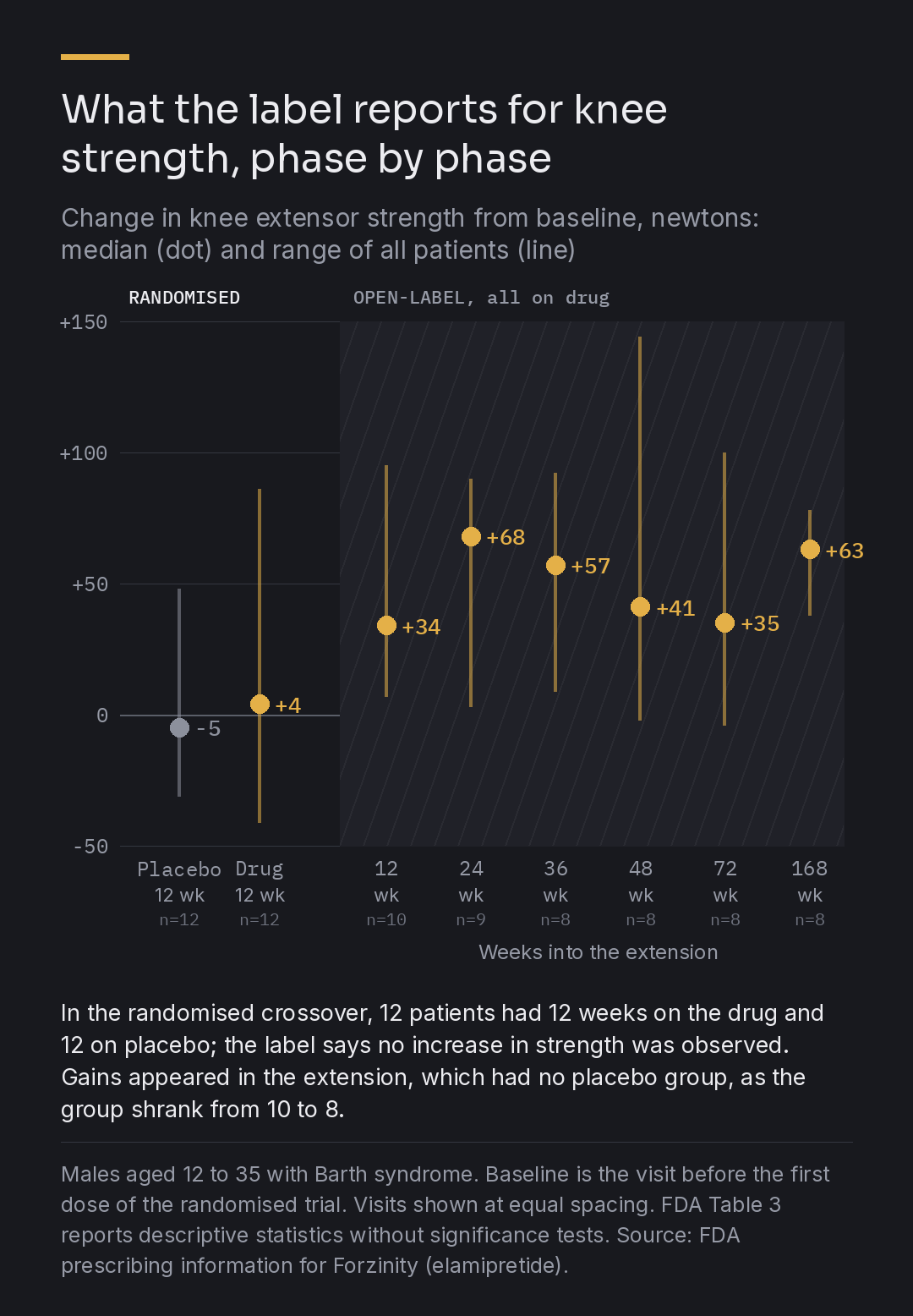
Muscle strength, measured at the knee with a handheld device that records force in newtons, was a secondary goal. After 12 weeks the median change from the start was plus 4 newtons on the drug and minus 5 on placebo, with individual results on the drug ranging from a loss of 41 to a gain of 86. The label's summary of that period is one sentence: increases "were not observed during the randomized trial but were observed during the extension period".
The open-label years
Ten of the twelve went on to an open-label extension, in which everyone took the drug and everyone knew it. Eight were still there at week 168, and three reached 192 weeks in total. In this phase the strength numbers moved. Measured from the visit before the first dose of the randomised trial, the median gain was 34 newtons at week 12 of the extension and between 35 and 68 newtons at every later visit the label reports.
Walking was reported on a different baseline. The 2024 report of the extension gives a cumulative improvement of 96.1 metres in the six-minute walk at week 168, measured from the start of the extension rather than from the start of the trial.
An open-label extension cannot separate a drug's effect from the passage of time, from practice at the tests, from the encouragement of being in a trial, or from the fact that the people who stay are not always like the people who leave. The group shrank from 10 to 8, and the strength figures in the label are descriptive: medians and ranges, without a comparison group or a significance test.
A 2022 retrospective natural history comparison tried to supply the missing comparison. It set the 8 treated patients from the extension against 19 untreated people with Barth syndrome from existing records, using statistical weighting to balance measured starting characteristics. On strength, the paper's abstract and results text report adjusted differences in change of 40.8 newtons at week 64 and 56.7 at week 76 in favour of the treated group; its own Table 3 repeats the week-64 figure in the week-76 row. The authors list the study's "observational nature and the limited number of patients" as limitations and note that the analysis could not account for all differences in medical care between patients. Stealth BioTherapeutics funded the study, and two of the co-authors, Anthony Abbruscato and Jim Carr, were company employees.
A larger trial, a different disease
A substantially larger randomised trial studied a different population. MMPOWER-3, reported in Neurology in 2023, enrolled 218 adults with primary mitochondrial myopathy, a group of genetic diseases that weaken muscle by impairing how mitochondria make energy. Half received elamipretide for 24 weeks and half placebo. It assessed similar primary outcomes, the six-minute walk and fatigue, with a different disease-specific fatigue questionnaire, and missed both. On the walk, the difference between the groups was minus 3.2 metres, with a 95 per cent confidence interval from minus 18.7 to plus 12.3. The authors' summary is plain: elamipretide "did not improve outcomes" on either measure.
After three participants were reclassified, 59 of the 218 had defects in nuclear DNA. In a post hoc walking analysis involving 29 participants per group, their adjusted improvement from baseline to week 24 was 25.2 metres greater with elamipretide than with placebo. The subgroup with defects in mitochondrial DNA showed no statistically significant walking difference. The authors call the finding "encouraging and hypothesis generating"; it needs confirmation in a trial designed for that group. MMPOWER-3 was funded by Stealth BioTherapeutics, which, the paper states, took part in designing the study.
What the injections did
In the Barth trial, all 12 patients had a reaction at the injection site while on the drug, against 8 of 12 on placebo. Redness was reported in all 12 on the drug and 3 on placebo, pain in 9 and 5, and hardening and itching each in 8 on the drug and 2 on placebo. In MMPOWER-3, injection site reactions were the most common side effects, and 7.3 per cent of people stopped the drug because of an adverse event, against 1.8 per cent on placebo. Serious adverse events were reported in 4.6 per cent on the drug and 2.8 per cent on placebo, and none was judged to be caused by treatment.
The label adds two warnings. Allergic reactions, "including serious allergic reactions requiring emergency medical intervention", have been reported, and can appear from minutes to months after the first dose. And because the product contains benzyl alcohol as a preservative, it is not approved for newborns. Rises in a type of white blood cell, the eosinophils, were frequent in studies lasting 30 days or more; the label says counts generally peaked around 90 days and returned to baseline after 6 to 12 months of continued treatment or after discontinuation, and they were not associated with symptoms or other laboratory changes.
Who this applies to
Every person in the trials described here had a rare genetic disease of the mitochondria, confirmed by a genetic test. The Barth patients were all male, aged 12 to 35, and 11 of the 12 were white. The approval covers Barth syndrome only, in people of at least 30 kilograms. None of these trials tested healthy people who train.
What it cannot say
The approval rests on a placebo phase in twelve patients in which neither walking nor fatigue beat placebo, and on an open phase in which strength rose without a comparison group. Continued approval may depend on verification of clinical benefit in a confirmatory trial. In MMPOWER-3, involving 218 adults with primary mitochondrial myopathy, the drug missed both primary endpoints. What the record does not yet show, in a placebo-controlled comparison, is the strength gain written into its approved use.
Sources
- FDA prescribing information for Forzinity (elamipretide), openFDA record effective 10 December 2025, via DailyMed dailymed.nlm.nih.gov
- Drugs@FDA, application 215244 (Forzinity), original approval 19 September 2025 accessdata.fda.gov
- Thompson et al., randomised trial and open-label extension of elamipretide in Barth syndrome (TAZPOWER), Genetics in Medicine, 2021 doi.org
- Thompson et al., 168-week open-label extension of TAZPOWER, Genetics in Medicine, 2024 doi.org
- Hornby et al., natural history comparison study of elamipretide in Barth syndrome, Orphanet Journal of Rare Diseases, 2022 doi.org
- Van den Eynde et al., identifying responders to elamipretide in Barth syndrome, Orphanet Journal of Rare Diseases, 2023 doi.org
- Karaa et al., elamipretide in primary mitochondrial myopathy, the MMPOWER-3 randomised trial, Neurology, 2023 doi.org
- Tung et al., elamipretide: a review of its structure, mechanism of action and therapeutic potential, International Journal of Molecular Sciences, 2025 doi.org
For educational purposes only. Not medical advice.
Every set as lifted, drop sets and myo-reps included.
First month free for new subscribers.