
Two molecules are sold as CJC-1295. The FDA found published human studies of only one, all in healthy adults
CJC-1295 is the name on two different substances. Both are man-made versions of growth hormone releasing hormone, the signal the brain sends to release growth hormone. One, developed by the Canadian company ConjuChem, carries an extra chemical arm called a Drug Affinity Complex, or DAC, that makes it attach to albumin in the blood and stay active for days. The other has no DAC.
Websites sell both, often without saying which salt form is in the vial, and the US Food and Drug Administration wrote in 2024 that these "inconsistent naming conventions" are a safety risk because patients "may be dosed with a different" substance than the one their physician ordered. In the same review, the FDA found three published papers on humans, all apparently on the version with DAC and all in healthy adults. For the version without DAC, it found no human studies, and no studies establishing whether it is pharmacologically active. That is a gap in the evidence, not proof that it does nothing.
What the studies measured
The FDA's 2024 review describes small groups of healthy adults, mostly men, most of whom received a single injection under the skin. The first and largest paper, published by Teichman and colleagues in 2006 with substance made by ConjuChem, reported two randomised, placebo-controlled trials in adults aged 21 to 61. After one injection, average growth hormone rose two- to tenfold for six days or more, and IGF-1, the blood marker that growth hormone drives, rose 1.5- to threefold for 9 to 11 days. In the single-injection trial, the FDA reports that IGF-1 went above the normal range for age and sex only among participants given the highest dose. In the second trial, with repeated injections, IGF-1 stayed above its starting level for up to 28 days.
A second paper, by Ionescu and Frohman, sampled blood every 20 minutes overnight in 12 healthy men aged 20 to 40, before and one week after a single injection. Growth hormone kept its natural pulses, but the low points between pulses rose 7.5-fold, and average IGF-1 went from 165 to 240 nanograms per millilitre, about 45% higher. No man went above the upper limit of normal. A third paper was a later analysis of blood proteins in samples from 11 of the same men.
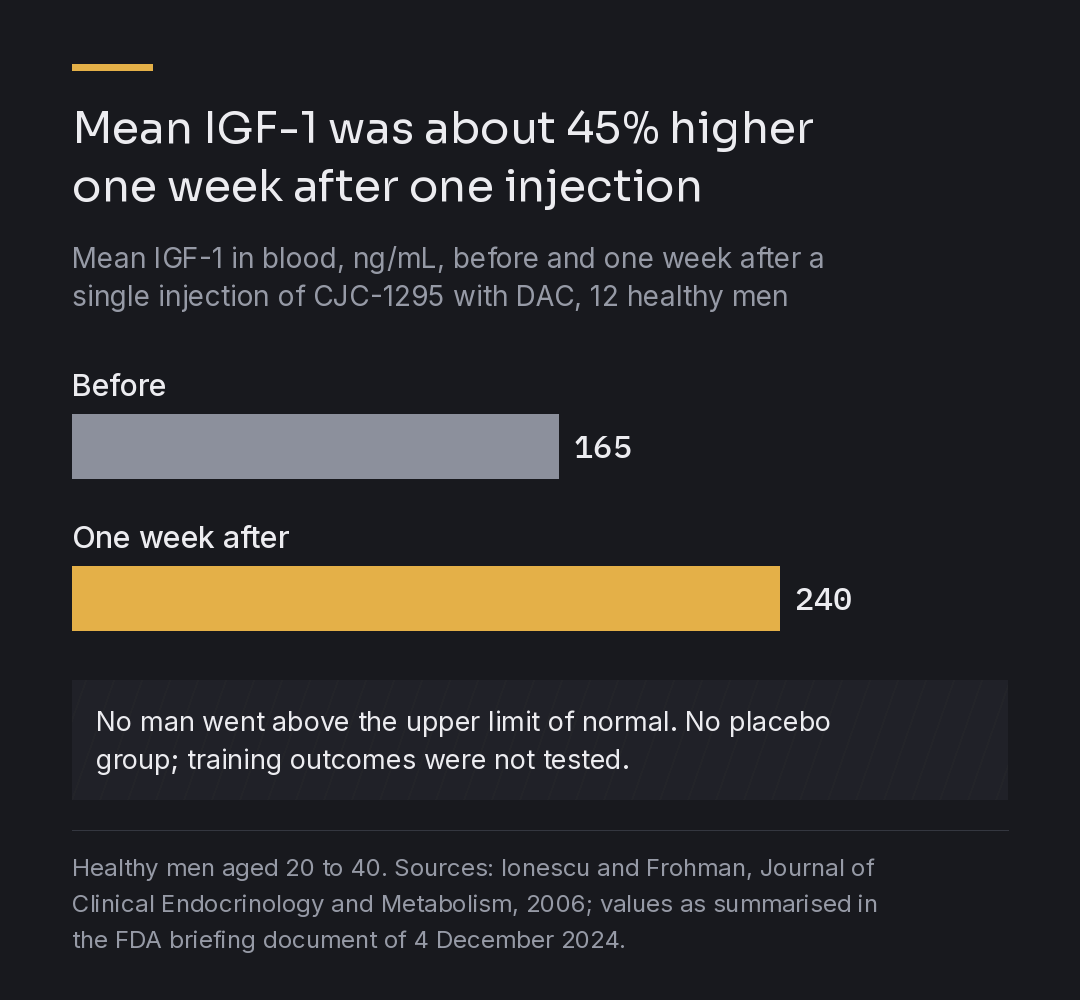
These papers examined hormone responses and changes in blood proteins. In the FDA's words, "they did not measure endpoints such as changes in body composition", and none of them establishes gains in strength or muscle.
What people reported
In the first Teichman trial, 33 of 35 people given CJC-1295 reported an adverse event, against 2 of 7 on placebo. About 70% had reactions at the injection site. Headache affected 63% against 14% on placebo, diarrhoea 43% of those on the drug and none on placebo, and 30% had flushing, warmth and a brief drop in blood pressure, again only on the drug. Most of these were more common at higher doses. In the Ionescu study, the FDA notes a dose-dependent increase in heart rate. The two papers that discussed adverse events reported no serious events; the protein-analysis paper did not discuss them. Studies this small and this short cannot establish long-term safety.
The trial that stopped
The FDA identified one trial in patients: a phase 2 study run by ConjuChem in people with HIV and excess abdominal fat. Its registry entry lists it as terminated in 2006, with no results posted. According to news reports from 2006 cited in the FDA's review, one participant reported chest discomfort two hours after his eleventh weekly injection; an electrocardiogram confirmed a heart attack, and he died about an hour later. The attending physician's most likely explanation was undiagnosed coronary artery disease with a ruptured plaque. The trial was stopped, ConjuChem withdrew CJC-1295 from clinical trials, and the trial's data have not been published. The sources reviewed here do not establish whether CJC-1295 contributed to the death.
Where the rules stand
CJC-1295 is not an approved medicine in the United States: our searches of the FDA's approvals database on 11 November 2026 found no record. In 2024 the FDA recommended excluding all five forms it evaluated, with and without DAC, from the list of bulk substances that pharmacies may use for compounding under section 503A. On 4 December 2024 its Pharmacy Compounding Advisory Committee voted on each form: 13 to 0 against adding four of them and 12 to 1 against the fifth. The vote was advisory. The agency's list of compounding risks, current as of 22 April 2026, records CJC-1295 among substances previously in its high-risk category whose nominations were withdrawn, and states that the FDA "has identified serious adverse events associated with CJC-1295 including increased heart rate and systemic vasodilatory reaction. Available clinical data are limited." The same entry flags possible immune reactions and uncertainty about peptide impurities and how the substance is characterised.
The World Anti-Doping Agency's 2026 Prohibited List names CJC-1295 among growth hormone releasing factors in class S2, prohibited at all times, in and out of competition.
What it means for a blood test
The hormone studies show that CJC-1295 with DAC can raise IGF-1 for more than a week after one injection, sometimes while values stay within the normal range. They do not establish improved strength, muscle gain or long-term safety. For the version without DAC, the FDA found no human studies in its 2024 review.
Sources
- US Food and Drug Administration, briefing document on CJC-1295 for the Pharmacy Compounding Advisory Committee, 4 December 2024 fda.gov
- Teichman and colleagues, Journal of Clinical Endocrinology and Metabolism, 2006: CJC-1295 in healthy adults doi.org
- Ionescu and Frohman, Journal of Clinical Endocrinology and Metabolism, 2006: growth hormone pulses after CJC-1295 doi.org
- ClinicalTrials.gov, NCT00267527: phase 2 study of CJC 1295 in HIV patients with visceral obesity (ConjuChem), terminated clinicaltrials.gov
- US Food and Drug Administration, final summary minutes of the Pharmacy Compounding Advisory Committee, 4 December 2024 fda.gov
- US Food and Drug Administration, bulk drug substances for compounding that may present significant safety risks (page current as of 22 April 2026) fda.gov
- World Anti-Doping Agency, 2026 Prohibited List wada-ama.org
For educational purposes only. Not medical advice.
Every blood draw, followed against its reference band.
First month free for new subscribers.