
PT-141 is approved only for women. The largest trial we found in men carries a warning from its own journal
PT-141 circulates outside pharmacies as a sexual enhancer. In the United States its approved form, Vyleesi, is a medicine for one group only: premenopausal women with acquired, generalized low sexual desire that causes them distress and has no other medical, relationship or drug explanation. Its label says it "is not indicated for the treatment of HSDD in postmenopausal women or in men" and "is not indicated to enhance sexual performance." The studies in men that we could assess are early laboratory experiments run with the developer and one larger randomized trial that its own journal has since flagged.
What it is
Bremelanotide is a man-made relative of alpha-melanocyte-stimulating hormone, a signal the body uses both in skin colour and in the brain. According to its label, it activates several melanocortin receptors without being selective; type 1, which drives skin pigmentation, and type 4, found across the brain, are the most relevant at the doses used. The label states that how it improves low desire in women "is unknown." It was developed by Palatin Technologies, and the US Food and Drug Administration approved it on 21 June 2019 under application NDA 210557. The current label, effective 5 November 2026, lists Cosette Pharmaceuticals as the company.
What was tested in men
Palatin's first published human studies were in men with erectile dysfunction. In two studies published in 2004, healthy men and men with erectile dysfunction were given the drug or placebo and their erections were measured with a device in a laboratory, in some cases while they watched sexual material. One, with a nasal spray, included men whose erectile dysfunction did respond to Viagra; the other, with injections under the skin, included men who reported an inadequate response to it. Both reported significant erectile responses compared with placebo at the higher dose levels tested; in the nasal-spray study, flushing and nausea were the most common side effects. A third study, in 2005, gave 19 men the nasal spray together with a low dose of sildenafil, and reported a stronger laboratory response than with sildenafil alone. Leonard Diamond of Palatin is an author of all three, and all three measured erections in a laboratory rather than sex at home. Reviews from the same period refer to further phase 2 trials in men whose full results we did not find.
The largest randomized trial in men that we found came from elsewhere. In 2008 the Journal of Urology published a study by Safarinejad and Hosseini, from a hospital in Tehran, of 342 married men aged 28 to 59 whose erectile dysfunction had not responded to sildenafil. The abstract reports what it calls "positive clinical results" in 51 men (33.5%) on the nasal spray against 13 (8.5%) on placebo, greater intercourse satisfaction, and more drug-related side effects. Those counts and percentages imply denominators of about 152 and 153, not the 172 and 170 men randomized, and the abstract does not explain the difference.
In 2023 the Journal of Urology attached an expression of concern to that paper. The PubMed record of the notice carries no explanation, so we do not know the journal's reasons.
Separately, the same first author published a trial of bremelanotide in women in the Journal of Sexual Medicine in 2008, and that paper has been retracted. It is a different paper and a different editorial decision; nothing in the records we have says the men's trial was flagged for the same reasons. The retraction notice says the journal re-reviewed all of his papers after other journals retracted his work, that reviewers raised "multiple concerning questions about the methodology, results, and statistical interpretation", and that he "chose not to respond" when asked for his original data.
A ClinicalTrials.gov search we ran on 12 November 2026 returned no registered trial of bremelanotide in men with erectile dysfunction. The registered studies it did return are in women, or in other conditions and open to both sexes.
What was tested in women
The approval rests on two identical phase 3 trials, RECONNECT, which randomized 1,267 premenopausal women to bremelanotide or placebo for 24 weeks. Combining both trials, desire improved by 0.35 points more than on placebo, on a scale that runs from 1.2 to 6, and distress about low desire fell by 0.33 points more, on a scale from 0 to 4. Both differences were statistically significant. The label also reports that there was "no significant difference" between the groups in the number of satisfying sexual events, a secondary outcome. It reports that 18% of women on the drug stopped because of side effects, against 2% on placebo.
In a 52-week open-label extension, 684 of the 856 eligible women chose to continue and 272 completed it. The authors reported sustained improvement and no new safety signals, but everyone knew they were taking the drug, there was no placebo group, and those who continued had chosen to.
How much the benefit is worth is disputed. A 2021 re-analysis by the psychologist Glen Spielmans, using the FDA application data, found results similar to the published ones, but argued that most outcomes listed in the trial protocols went unreported and that women on placebo were more likely to finish the trial and join the follow-up study, a sign, in his reading, that they preferred placebo. His paper later received an erratum whose content we could not check. Kingsberg and colleagues, two of them from Palatin, published a reply titled "Failure of a Meta-analysis"; the record we have contains no abstract, so we cannot assess their argument.
What the label warns
The label describes transient changes in blood pressure and heart rate after each dose: rises of up to 6 mmHg systolic and 3 mmHg diastolic at their peak, two to four hours after dosing, and a fall in heart rate of up to 5 beats per minute, usually back to baseline within 12 hours. A 2017 study using 24-hour blood pressure monitors in 397 women found the same pattern. The label contraindicates the drug in people with uncontrolled high blood pressure or known cardiovascular disease, and does not recommend it for people at high risk of cardiovascular disease. None of these measurements establishes how the drug behaves in men, including men on testosterone therapy.
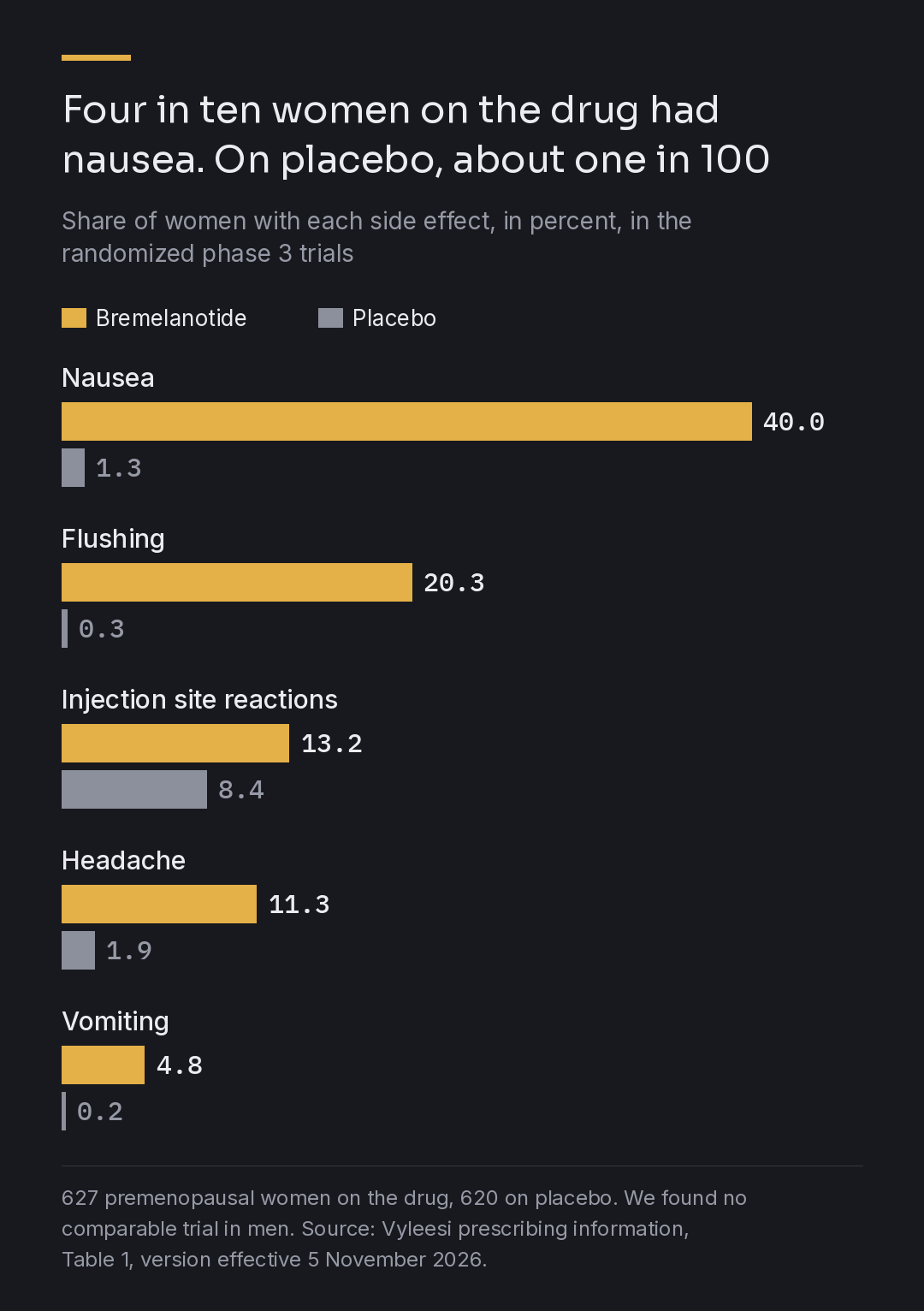
Nausea affected 40% of women in the trials, and 13% received anti-nausea medication. The label also describes darkening of patches of skin, including the face, gums and breasts, in 1% of women in the phase 3 trials, with a higher risk in people with darker skin and with daily use, and says that in some patients it was not confirmed to have resolved. In a separate safety analysis of repeated daily exposure, it affected more than a third of participants.
Where else it shows up
Outside the prescription market, Italian forensic toxicologists identified bremelanotide, along with the related tanning peptide melanotan II, in samples police had seized together with anabolic steroids and other drugs intended for the black market of bodybuilders. A phase 2 trial testing bremelanotide together with tirzepatide in obesity, with a recorded start date in August 2024, is listed as active and not recruiting, with no results posted.
What it means for a blood pressure reading
The studies in men that we could assess are early laboratory experiments run with the developer and one larger randomized trial that its journal now flags; reviews from the time also mention further phase 2 trials whose full results we did not find. The large controlled safety dataset, including the rise in blood pressure, the fall in heart rate, nausea and skin darkening, comes from women. Vyleesi is not indicated for men, and a normal blood pressure reading does not show that the drug is safe for a particular man.
Sources
- US Food and Drug Administration, Vyleesi (bremelanotide) prescribing information, NDA 210557, version effective 5 November 2026 dailymed.nlm.nih.gov
- Kingsberg and colleagues, Obstetrics and Gynecology, 2019: two randomized phase 3 trials of bremelanotide (RECONNECT) doi.org
- Simon and colleagues, Obstetrics and Gynecology, 2019: 52-week open-label extension of RECONNECT doi.org
- Clayton and colleagues, Journal of Women's Health, 2022: safety profile of bremelanotide across the clinical development program doi.org
- Spielmans, Journal of Sex Research, 2021: re-analysis of the phase 3 bremelanotide trials doi.org
- Kingsberg and colleagues, Journal of Sex Research, 2021: reply to the re-analysis doi.org
- Diamond and colleagues, International Journal of Impotence Research, 2004: intranasal PT-141 in healthy men and men with erectile dysfunction doi.org
- Rosen and colleagues, International Journal of Impotence Research, 2004: PT-141 under the skin in healthy men and men with an inadequate response to Viagra doi.org
- Diamond and colleagues, Urology, 2005: intranasal PT-141 with sildenafil in men with erectile dysfunction doi.org
- Safarinejad and Hosseini, Journal of Urology, 2008: bremelanotide in men who did not respond to sildenafil doi.org
- Journal of Urology, 2023: expression of concern on Safarinejad and Hosseini 2008 doi.org
- Journal of Sexual Medicine: retraction of Safarinejad 2008, bremelanotide in women with arousal disorder doi.org
- White and colleagues, Journal of Hypertension, 2017: ambulatory blood pressure after bremelanotide doi.org
- Mestria and colleagues, Drug Testing and Analysis, 2021: melanotan II and bremelanotide seized for the black market of bodybuilders doi.org
- ClinicalTrials.gov, NCT06565611: phase 2 study of bremelanotide with tirzepatide in obesity clinicaltrials.gov
For educational purposes only. Not medical advice.
Sleep, heart rate, blood pressure and glucose, read in one place.
First month free for new subscribers.