
BPC-157: a large animal literature, sparse human evidence, and a split vote at the FDA
On 23 July 2026, a panel of outside advisers to the US Food and Drug Administration took up BPC-157. The formal questions were whether two forms of it, the free peptide and its acetate salt, should be placed on the list of bulk substances that pharmacies may use to compound medicines. The agency's own reviewers had recommended against both. The panel voted 8 to 6, with one abstention, to recommend it, ABC News reported; the report did not distinguish the outcomes for the two forms. The vote does not bind the FDA.
The split says something about the compound itself. BPC-157 has a literature of more than two hundred papers and a reputation, in gyms and online, for healing tendons and muscle. The human evidence behind that reputation is thin. The newer studies, assessed in an October systematic review, were small and had no comparison group. The older placebo-controlled studies concerned healthy volunteers and a bowel disease, not injury recovery.
This is what is known about it, and how each piece of that knowledge was produced.
A fragment with a nickname, not a drug name
BPC-157 is a synthetic peptide of 15 amino acids, GEPPPGKPADDAGLV in the one-letter code, reported to match a fragment of a larger protein its discoverers called Body Protection Compound and said they found in human gastric juice. In the FDA's July briefing document, the free peptide has the molecular formula C62H98N16O22 and a molecular weight of 1,419.5 grams per mole. It first appeared in the scientific literature in 1993, and it has circulated under development codes, PL 14736 and Bepecin.
What it does not have is a regulated identity. BPC-157 is a common name, not an international nonproprietary name or a US Adopted Name, and no pharmacopoeia in the United States, Europe, Japan or the international system has a monograph for it. The FDA wrote that it has "encountered multiple salts, and derivatives, including different active moieties, sold commercially under the same common name." The agency treats the free peptide and the acetate salt as two different active ingredients, and judged neither "well-characterized" on the evidence available: the nominations did not establish the tests that would define identity, purity, impurities and aggregates for the products proposed.
That matters before any question of whether it works. Two vials with the same name on the label are not guaranteed to hold the same molecule.
What has been measured in people
The first human data predate the current interest by two decades. In the early 2000s, BPC-157 was tested as an enema in a placebo-controlled study of healthy volunteers, where 24 of 32 randomised people received it, and in a placebo-controlled study of people with ulcerative colitis, an inflammatory bowel disease, with 53 randomised and 46 completing. Both survive only as conference abstracts. The FDA found them hard to interpret because of how little they reported. The abstracts on healthy volunteers listed headache and flatulence as the most frequent side effects, with no obvious difference in frequency or severity from placebo, and reported plasma levels that were generally undetectable or below the limit of quantification.
A phase 1 trial in healthy volunteers, registered in 2015 with a planned 42 participants, never posted results. The registry entry has not been updated since 2015, and the FDA could not find a published study.
The newer evidence was gathered in a systematic review published on 8 October 2026 in Acta Orthopaedica Belgica. Its authors searched four databases up to 1 June 2026 for human studies of BPC-157 in any language and for any condition. Out of 864 records, three studies met their criteria, with 30 participants analysed.
Sixteen had knee pain and received injections into the joint; 14 reported improvement, and four of the 16 had also received a second peptide, thymosin beta-4. Twelve women with interstitial cystitis, a chronic bladder condition, received it into the bladder; 10 reported that their symptoms had resolved. Two healthy adults received it intravenously, with no meaningful change in heart, liver, kidney or thyroid markers. None of the studies reported a side effect attributed to treatment.
The review rated all three studies as poor quality and the certainty of the evidence as very low. The reasons are worth reading slowly. No study had a control group, so improvement cannot be separated from placebo effects, natural fluctuation or other care. Neither efficacy study recorded how bad symptoms were at the start. The cystitis study scored results on a scale whose top category ran from 76% to 100% improvement. Two of the studies used product from unnamed compounding pharmacies, with no independent test of what was in it. Both people in the safety study had used BPC-157 before.
And all three came from clinics in Orlando, Florida, under the same lead author, who, the review notes, founded an advocacy organisation against regulatory restrictions on these peptides. No conflicts of interest were declared.
The review also traced an error through earlier literature. Several reviews had said that blood levels of BPC-157 return to baseline within 24 hours of an infusion in humans. The study they cited did not measure blood levels.
How it is supposed to work
The theory comes almost entirely from animals. In rats, studies have reported that BPC-157-related substances protected the gut, the liver and other tissues against a long list of deliberate injuries. Researchers have proposed several explanations: more growth factors and their receptors, less inflammation, new blood vessel growth, and more nitric oxide, a molecule that relaxes blood vessels.
The FDA's reviewers summarised those proposals and then listed what is missing. No dose-response relationship has been established for the reported protection against gut and liver injuries. The molecular targets of BPC-157 have not been identified. The mechanisms, in their words, "remain poorly understood," which makes it hard to judge whether the effects seen in rats are biologically plausible in people.
Tendons are central to that reputation, and they show how thin even the animal case can be. In a rat study published this year, eight animals per group had a repaired Achilles tendon and received BPC-157, a related peptide called TB-500, both, or nothing. On the total tissue scores, the BPC-157 group did better than controls only numerically, without statistical significance; the clearest biomechanical advantage was in the TB-500 group. One small rat experiment proves nothing either way. It is a reminder that the animal literature is not uniform.
Human tissue has entered the picture only recently, and only in a dish. In a study published in May, researchers in Ankara took leftover segments of the internal mammary artery from 12 patients having bypass surgery, cut them into rings and exposed them to BPC-157. The rings relaxed, more so when their inner lining was intact. Blocking nitric oxide production reduced the relaxation and largely removed the advantage of an intact lining, and the authors note residual effects that point to other mechanisms. They call it early mechanistic evidence. It shows the molecule can act on human vessel tissue; it does not establish any effect in a living person.
One name on most of the papers
For a compound this discussed, the research has an unusually narrow base. A search of MEDLINE records that name BPC-157 in the title or abstract returned 222 papers on 5 November 2026. P. Sikirić, of the Department of Pharmacology at the University of Zagreb's School of Medicine, is an author on 172 of them. From 1993 to 2024, the share was 157 of 176.
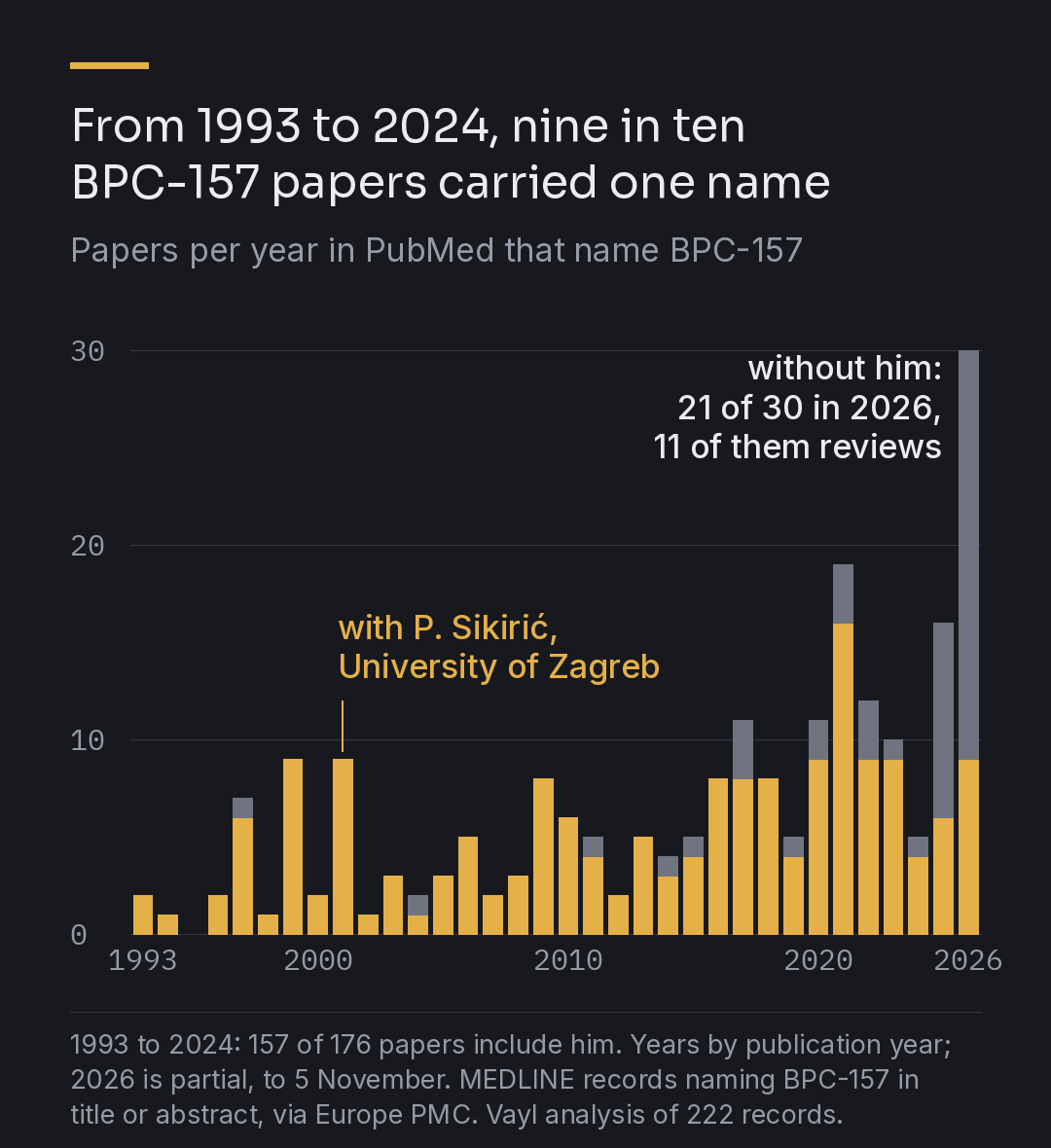
Authorship this concentrated does not make the findings wrong, and a count of names cannot say how often any specific result has been independently reproduced. Most matching papers share this one coauthor. Of the 21 papers in 2026 without him, 11 are indexed as reviews rather than new experimental reports.
What nobody knows
The sparse plasma readings from the enema studies do not describe how BPC-157 is absorbed, distributed and cleared in people. The FDA said so directly: "There is no information to assess the pharmacokinetics of BPC-157 in humans."
The agency's safety concerns are mostly about what has not been tested. Peptides injected under the skin or sprayed into the nose can provoke an immune response, and peptides can clump into aggregates that make that more likely. The FDA identified no study that formally investigated the immunogenicity of BPC-157 products, and found the characterisation of aggregates inadequate. It found no studies of whether BPC-157 causes cancer. In the 28-day toxicity studies in rats and dogs it reviewed, it noted signals worth following: changes in clotting times and in liver-related blood tests, with no longer studies to show whether they persist or grow. The FDA's adverse event database holds reports of injection site reactions, shortness of breath, and darkening of the skin and gums in people using BPC-157; the agency says it is unclear whether the peptide caused them.
The review offers no results specific to athletes. Its participants averaged 59.5 years of age. No placebo-controlled results have been published for a muscle or tendon injury in people who train.
Where the rules stand
No product containing BPC-157 is approved for medical use in any country, according to the FDA's briefing.
In the United States, it had been on the FDA's list of bulk substances that may present significant safety risks for compounding. The FDA's page on those substances, dated 22 April 2026, places it among substances whose nominations were withdrawn. The FDA then evaluated it on its own initiative, for ulcerative colitis, one of the uses it had been nominated for, and recommended in its July briefing against placing either form on the list. ABC reported a favourable advisory vote. We found no FDA announcement acting on that vote as of 5 November.
In sport the answer is simpler. The World Anti-Doping Agency's 2026 Prohibited List names BPC-157 in section S0, substances with no approval for human therapeutic use, which are banned at all times, in and out of competition.
What would change the picture
A randomised, placebo-controlled phase 2 trial in acute hamstring strain, sponsored by Hudson Biotech, plans to enrol 120 participants. The registry, last updated in February, lists it as recruiting from a February 2026 start, with primary completion estimated for February 2027 and study completion for February 2028. It could provide the first controlled evidence for an acute muscle injury.
The review's authors add their own caution: one trial, however well designed, would not establish that the compound works or that it is safe. What the FDA's briefing found missing is a longer list: a defined molecule, controlled trials, and safety followed for longer than a few weeks. For now the evidence is lopsided. The rats are numerous. The people are few, and in the newest studies that reported a benefit, nobody recorded where they started.
Sources
- Poolton and colleagues, Acta Orthopaedica Belgica, 2026: systematic review of human evidence for BPC-157 doi.org
- FDA briefing document on BPC-157 (free base) and BPC-157 acetate, Pharmacy Compounding Advisory Committee, July 2026 fda.gov
- FDA, Pharmacy Compounding Advisory Committee meeting of 23 and 24 July 2026: agenda, questions and documents fda.gov
- FDA, bulk drug substances that may present significant safety risks (category 2), page current as of 22 April 2026 fda.gov
- ABC News, 23 July 2026: FDA advisory committee votes to add BPC-157 to drug compounding list abcnews.com
- World Anti-Doping Agency, Prohibited List 2026, section S0 wada-ama.org
- Achilles tendon repair in rats with BPC-157 and TB-500, Joint Diseases and Related Surgery, 2026 doi.org
- Yildirim and colleagues, Journal of Clinical Medicine, 2026: BPC 157 in human internal mammary artery rings doi.org
- ClinicalTrials.gov NCT07437547: BPC 157 for acute hamstring muscle strain repair clinicaltrials.gov
- ClinicalTrials.gov NCT02637284: phase 1 study of BPC-157 in healthy volunteers clinicaltrials.gov
For educational purposes only. Not medical advice.
Every set as lifted, drop sets and myo-reps included.
First month free for new subscribers.