
Falling asleep: 2 to 3 minutes by wristband, 16 to 20 by athlete report, in a trial of four bedtime drinks
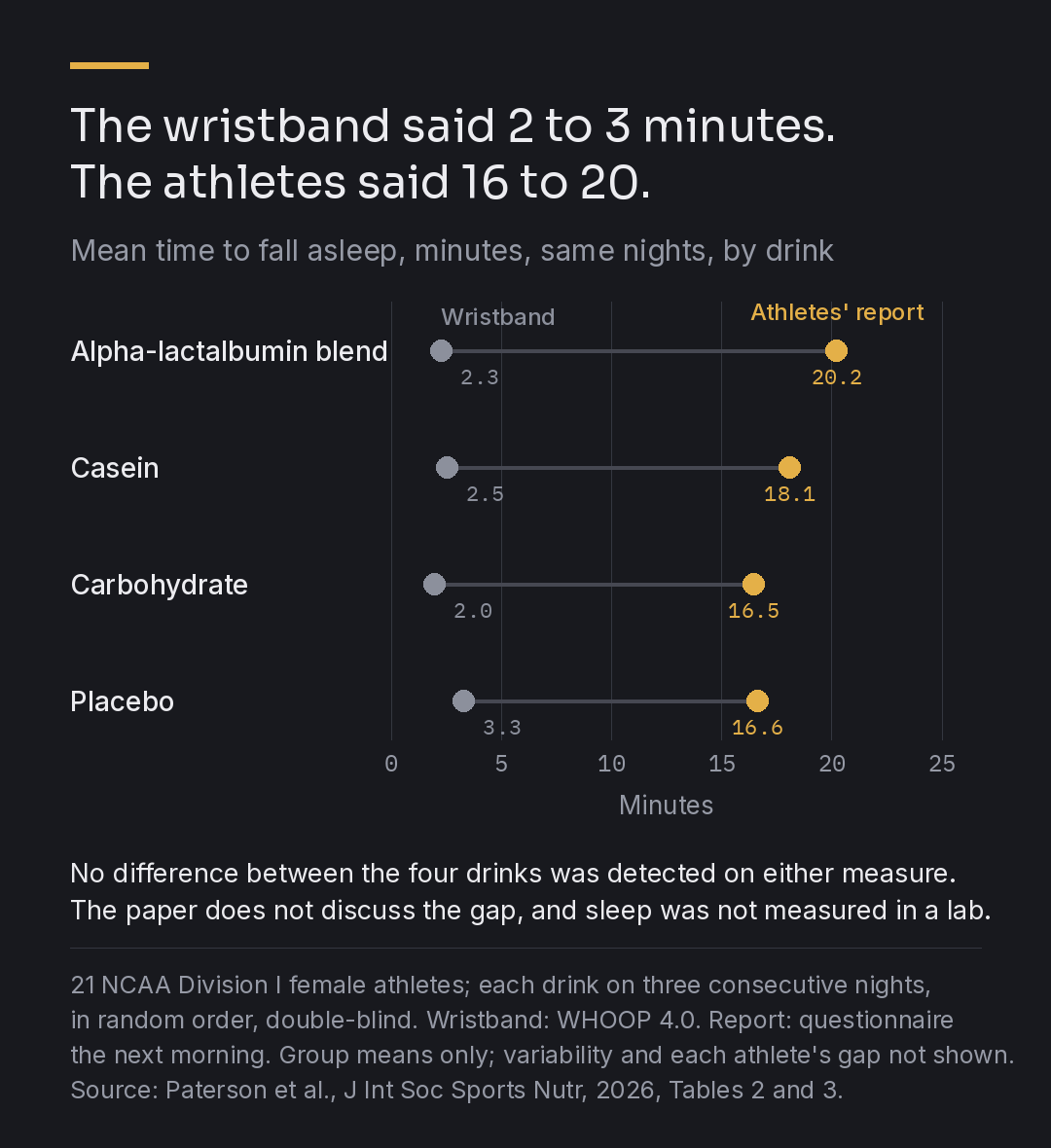
On the same nights, two instruments gave two different answers. By the wristband, these athletes took on average two to three minutes to fall asleep. By their own account the next morning, they took 16 to 20.
That gap is not the headline of the trial that produced it. The headline, published on 20 October in the Journal of the International Society of Sports Nutrition by a team at Florida State University, concerns a question many people who train ask: does what you drink before bed change how you sleep? Among the four drinks tested, no statistically significant differences in sleep were detected. The disagreement between the wristband and the athletes is what the trial shows on the side, and it may matter more to anyone who reads their own sleep numbers every morning.
Four drinks, one wristband
Twenty-five women from the university's top-division soccer, softball and tennis teams were recruited, aged 18 to 25, and 21 completed the trial. Each tried four drinks, three nights in a row each, in a random order: one with 40 grams of casein, one with 40 grams of a protein blend rich in alpha-lactalbumin, one with 40 grams of carbohydrate, all at 160 kilocalories, and a placebo of flavouring and sweeteners at 5. Neither the athletes nor the researchers knew which was which. Each drink was taken about 30 minutes before bed, as the last caloric intake of the day, and the athletes slept in their usual environments.
Sleep was measured by the WHOOP 4.0 band the athletes already wore for team monitoring: total sleep, time to fall asleep, sleep efficiency, overnight resting heart rate and heart rate variability. Each morning a short questionnaire asked how they had slept, how long falling asleep had taken and how recovered they felt.
Two clocks, one night
For every drink, the band's mean sat between 2.0 and 3.3 minutes and the athletes' mean estimate between 16.5 and 20.2. The condition means differ by 13.3 to 17.9 minutes. These are comparisons of group averages, not a measure of how far each athlete's own report was from her band, which the paper does not give.
The paper reports both numbers in neighbouring tables and does not discuss the difference. Nor can it say which is closer to the truth: polysomnography, the laboratory standard for sleep, was not used, and the authors list that as a limitation. The gap shows that the two measures did not agree, not which one was wrong.
What was not detected
Across the four drinks, the researchers detected no statistically significant differences in any sleep or recovery measure. Total sleep ranged from 7.47 to 7.62 hours, sleep efficiency from 91.5 to 92.0 per cent, resting heart rate from 53.5 to 54.1 beats a minute and heart rate variability from 98.2 to 103.9 milliseconds. The morning questionnaires showed the same flat picture. A glucose sensor was meant to follow the night as well, but training and matches knocked sensors off for most athletes, and complete data survived for six; in them, no difference between drinks was detected.
The authors had expected more. Their stated hypothesis was that the alpha-lactalbumin drink would beat the others, and that all three would beat the placebo. Neither predicted advantage was detected. They note that two earlier trials in rugby players found modest benefits with a much purer alpha-lactalbumin product, while the blend here was about 43 per cent alpha-lactalbumin.
The authors calculated that 18 participants would give 80 per cent power to detect an effect based on earlier research on time to fall asleep; 21 completed the trial. The difficulty is that the band put that time at two to three minutes, which leaves little room to detect a drink that shortens it further. And without the effect sizes and confidence intervals the methods section promises, the published results do not show what size of benefit or harm can be ruled out. In their conclusion the authors write that "any potential impact on sleep quality would still have been detected if present", a claim the reported data do not let a reader check.
What the registry says
The trial was first posted on ClinicalTrials.gov on 26 October 2023, before its recorded start on 23 January 2024, under NCT06102460. The paper cites a different number, the university's internal study code, as its ClinicalTrials.gov identifier. The registry version we downloaded lists the band's own sleep score and recovery score as the two primary outcomes; neither appears in the paper, which reports the band's underlying measures instead.
The registry also excludes people who use sleep aids, yet the paper reports two participants using sleep aids five to seven nights a week. It records 20 participants and a washout of at least one week between drinks; the paper reports 25 recruited, 21 completing and a minimum three-day washout. The documents do not explain these differences.
Who this applies to
These were young, healthy, closely monitored athletes without diagnosed sleep disorders. The authors suggest that their teams' performance staff may already have sleep protocols in place. Eight used hormonal contraception, and testing was not timed to the menstrual cycle. Among the 17 athletes with enough food logs, reported intake excluding the study drinks averaged 2,040 kilocalories a day, which the authors say likely reflects under-reporting, too little food, or both. Asked at the end of each period which drink they had taken, the athletes were right 36 per cent of the time, against 25 per cent by chance.
The drinks were packaged and coded by Actus Nutrition, which co-funded the study with the National Dairy Council. The senior author declares an unpaid seat on the International Protein Board.
What it cannot say
In 21 young female college athletes, over three nights per drink, the researchers detected no differences among the four drinks. The trial says nothing about eating before bed compared with not eating, and it does not establish whether the same results apply to people with poor sleep or diagnosed sleep disorders. What it does put on the record is that a wristband and the person wearing it gave group averages about a quarter of an hour apart on how long falling asleep took, and that this study cannot say which of the two to believe.
For educational purposes only. Not medical advice.
Sleep, heart rate, blood pressure and glucose, read in one place.
First month free for new subscribers.