
AOD-9604 missed its main weight-loss goal in 2007. In 2024 the FDA found no human data on injecting it under the skin
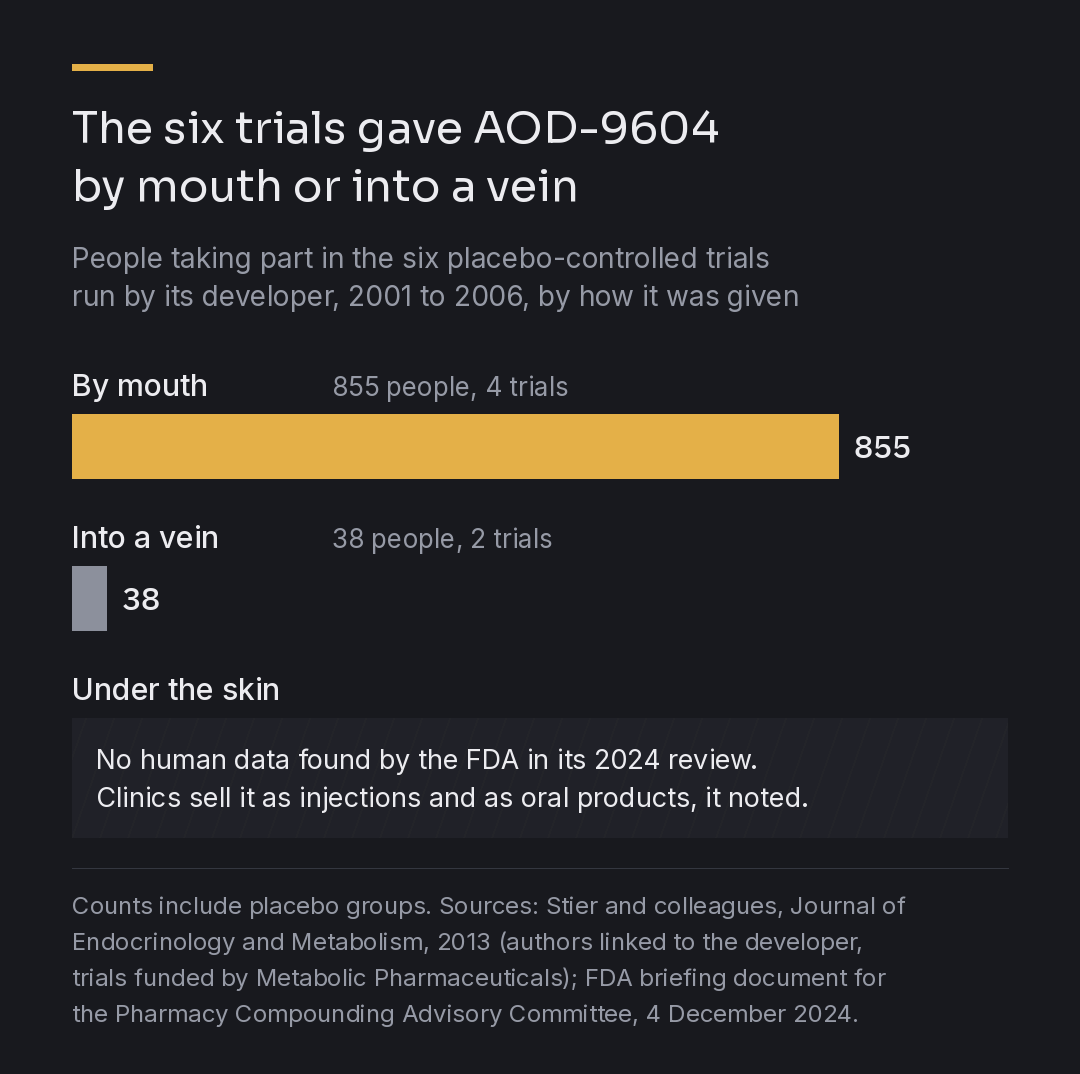
In February 2007 the Australian company Metabolic Pharmaceuticals told investors that the main goal of its largest trial of AOD-9604, a short piece of human growth hormone developed for fat loss, was "Not met". Weight loss beyond what a supervised diet and exercise programme achieved was under a kilogram on every dose and not statistically significant, and the company ended development for obesity. Its announcement gave no numerical results for changes in waist or body fat. All six of the company's trials gave AOD-9604 by mouth or into a vein. When the US Food and Drug Administration reviewed the substance in 2024, its search found no human data on it injected under the skin, although clinics market it as injections as well as oral products.
The trials
A 2013 paper in the Journal of Endocrinology and Metabolism summarises the safety data from all six trials, run between 2001 and 2006. It covers 893 participants, including those on placebo: 38 in two single-dose studies given into a vein, and 855 in four studies using capsules or tablets. The trials were funded by Metabolic Pharmaceuticals. One author held a stake in Metabolic's parent company, another was Metabolic's former medical director and a consultant to it, and the third worked for a consultancy advising the company. The paper presents safety findings, not weight-loss results.
The weight results come from company statements. In a 12-week trial of 300 adults with obesity, without a formal diet and exercise programme, the company said in 2007 that all five dose groups lost more weight on average than placebo, but the best of them "fell short of significance" on the main analysis, reaching it only in women. For those results the FDA found a 2005 conference abstract and wrote that it "did not locate a publication of the study methods and results".
The second, larger trial, called OPTIONS, was designed to confirm that signal under conditions the company described as closer to Phase 3. It enrolled 536 adults with obesity at 16 Australian sites. All started a dietitian-supervised diet and exercise programme four weeks before treatment, and 502 were then randomly assigned to one of three doses of tablets or placebo for 24 weeks. The main goal was a statistically significant weight loss against placebo at 12 weeks, and the trial was sized to detect a difference of 1.8 kilograms. In its announcement of 21 February 2007, the company reported that weight loss compared to placebo was "too low to reach statistical significance", and that at 12 or 24 weeks, "after allowing for the effects of the diet and exercise programme", it "was less than 1 kg in all dose groups". Waist reduction and body fat measured by whole-body DEXA scans were secondary outcomes. Under secondary endpoints the announcement states: "No relevant findings." It supplies no numerical waist-change or DEXA results.
The company offered its own reading. The drug effects may have been "overwhelmed by the effective weight loss programme", it wrote, and its conclusion was that AOD-9604 "does not combine or synergise with successful use of an ongoing diet and exercise programme, but may show some effect with moderate weight loss effort in females". That last point came from a subgroup of women who had lost less weight during the four weeks before treatment, one of several subgroups the trial had set out in advance. The FDA wrote in 2024 that the trial "does not appear" to have been published in the medical literature.
Why it was expected to work
The peptide copies the last fifteen building blocks of growth hormone, the end of the molecule linked to fat breakdown, with one extra amino acid added for stability. In obese mice, a 2001 study found that it reduced weight gain and increased fat burning, like growth hormone itself, without raising blood sugar. In cell tests it did not compete with growth hormone for its receptor. The FDA's 2024 review concluded that the molecular target and the mechanism behind these effects "remain unknown".
The safety record
The 2013 paper concludes that the safety profile was "indistinguishable from placebo". In the oral trials it reports no statistically significant differences in IGF-1, the hormone that growth hormone raises, between treatment and placebo groups, no evidence of worsening glucose tolerance, and no antibodies against the peptide in the people tested for them. The detailed results qualify that reassurance. In a single-dose oral study, a serious episode of diarrhoea was judged possibly related to treatment. In the 12-week trial, five people had a serious adverse event, all of them in groups taking AOD-9604: four cancers (two skin cancers other than melanoma, one melanoma and one breast cancer) and one benign fatty lump. The paper says the investigator judged none of them related to treatment, and points to the absence of a dose pattern, the high rate of skin cancer in Australia and the link between obesity and cancer. With 250 people on the drug and 50 on placebo, five events cannot settle the question either way, and the FDA wrote in 2024 that the reports gave insufficient information to assess whether the cancers were related. In one of the trials given into a vein, five of 23 men reported mild or moderate euphoria during drug periods and none on placebo, and one reported severe chest tightness judged possibly related.
The FDA's 2024 review adds what the trials do not cover. It found no studies in humans of how the substance is absorbed or handled by the body, by any route. It noted that peptides of this length can provoke immune reactions, and that impurities and clumping in compounded products can make that worse. In animal studies it found changes in bone-turnover markers in rats and in liver cells in monkeys that it treated as unresolved safety signals, and tests for genetic damage were inconclusive.
Where the rules stand
AOD-9604 is not an approved medicine in the United States: our searches of the FDA's approvals database on 11 November 2026 found no record. In 2024 the FDA recommended excluding it from the list of bulk substances that pharmacies may use for compounding under section 503A, and on 4 December 2024 its Pharmacy Compounding Advisory Committee voted 12 to 0 against adding it. The vote was advisory. The agency's list of compounding risks, current as of 22 April 2026, records AOD-9604 among substances previously in its high-risk category whose nominations were withdrawn, and still states that the FDA "lacks sufficient information to know whether the drug would cause harm when administered to humans". According to the FDA's 2024 review, Australia's Advisory Committee on Medicines Scheduling recommended and confirmed adding it to the poisons standard under performance and image enhancing drugs, for which possession without authority is illegal.
The World Anti-Doping Agency's 2026 Prohibited List names AOD-9604 as an example of a growth hormone fragment in class S2, prohibited at all times, in and out of competition.
What it means for your own numbers
If you track weight, waist or body fat, OPTIONS is the trial to read: it tested tablets alongside supervised diet and exercise, in adults with obesity. Its developer reported under a kilogram of extra weight loss on every dose, not statistically significant, and no numerical results for changes in waist or body fat. For injections under the skin, the FDA's 2024 review found no human data, so these tablet trials give no estimate of what those injections would do to weight, waist or body fat.
Sources
- Metabolic Pharmaceuticals announcement to the Australian Securities Exchange, 21 February 2007: phase 2B results of AOD9604 (OPTIONS study), filed with the US Securities and Exchange Commission sec.gov
- Stier and colleagues, Journal of Endocrinology and Metabolism, 2013: safety and tolerability of AOD9604 in humans doi.org
- US Food and Drug Administration, briefing document on AOD-9604 for the Pharmacy Compounding Advisory Committee, 4 December 2024 fda.gov
- US Food and Drug Administration, final summary minutes of the Pharmacy Compounding Advisory Committee, 4 December 2024 fda.gov
- US Food and Drug Administration, bulk drug substances for compounding that may present significant safety risks (page current as of 22 April 2026) fda.gov
- Heffernan and colleagues, International Journal of Obesity, 2001: growth hormone and a C-terminal fragment in obese mice doi.org
- World Anti-Doping Agency, 2026 Prohibited List wada-ama.org
For educational purposes only. Not medical advice.
Skinfold, bioimpedance and DXA, each reading compared only with its own method.
First month free for new subscribers.